



A growing body of clinical data on home optical coherence tomography (OCT) suggests the technology may alter how neovascular age-related macular degeneration (nAMD) is monitored between visits, with numerous studies aimed at defining its real-world impact. Speaking at the Retina World Congress in Fort Lauderdale, Florida, Courtney Crawford, MD, highlighted the DRCR Retina Network’s ongoing Protocol AO trial, a 600-patient study expected to clarify how nAMD management using home OCT (Scanly; Notal Vision) compares with standard treat-and-extend care.
“Home OCT is an urban myth, right?” joked Dr. Crawford, a vitreoretinal surgeon and owner of Star Retina and Star Vision Research in Burleson, Texas. “I would contend no—it’s actually pretty awesome.”
The Scanly system, which received de novo marketing authorization from the US Food and Drug Administration (FDA) in 2024, captures retinal images in the patient’s home and uploads them to a cloud-based platform where artificial intelligence (AI) algorithms analyze hyporeflective spaces (HRS), which may correspond to retinal fluid activity (Figure 1). Physicians can customize alert thresholds to identify early disease recurrence or worsening.
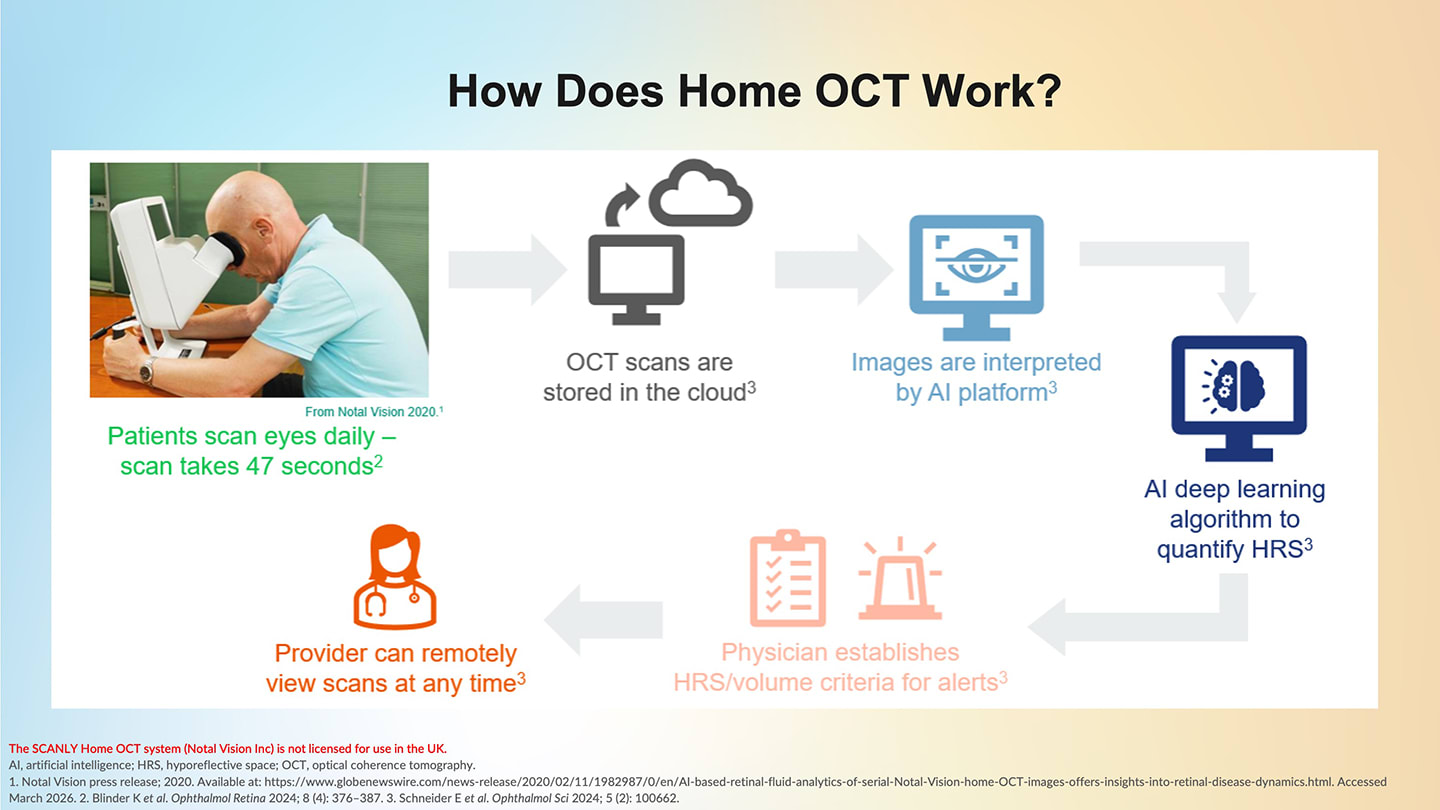
Figure 1. The Scanly home OCT system (Notal Vision) captures retinal images in the patient’s home and uses cloud-based AI analysis to identify hyporeflective spaces that may indicate retinal fluid activity in neovascular age-related macular degeneration.
Dr. Crawford emphasized that conventional clinic-based OCT monitoring may miss clinically significant fluctuations occurring between office visits. He described scenarios familiar to retina specialists: patients appearing stable on an every-8-week anti-VEGF regimen, only to later develop subretinal fibrosis or recurrent fluid that may have emerged between visits.
According to Dr. Crawford, home OCT could help answer several persistent clinical questions, including whether patients are maximally responsive to therapy, whether treatment intervals are appropriate, and when earlier retreatment might be necessary.
The presentation highlighted evidence from multiple pivotal studies evaluating home OCT in nAMD. In a prospective study led by Nancy Holekamp, MD, home OCT–guided monitoring helped extend average treatment intervals from 8 weeks to approximately 15 weeks in treatment-experienced patients.1 Another study by Jeffrey Heier, MD, involving a retrospective review of OCT images by 15 retina specialists, suggested that clinicians reviewing serial home OCT data would often have treated approximately one week earlier than occurred in routine clinical practice.2
Dr. Crawford said the findings underscore a disconnect between intermittent office-based OCT interpretation and the continuous nature of disease activity. He added that home OCT may also help clinicians better characterize the highly individualized patterns of retinal fluid fluctuation and treatment response seen in nAMD.
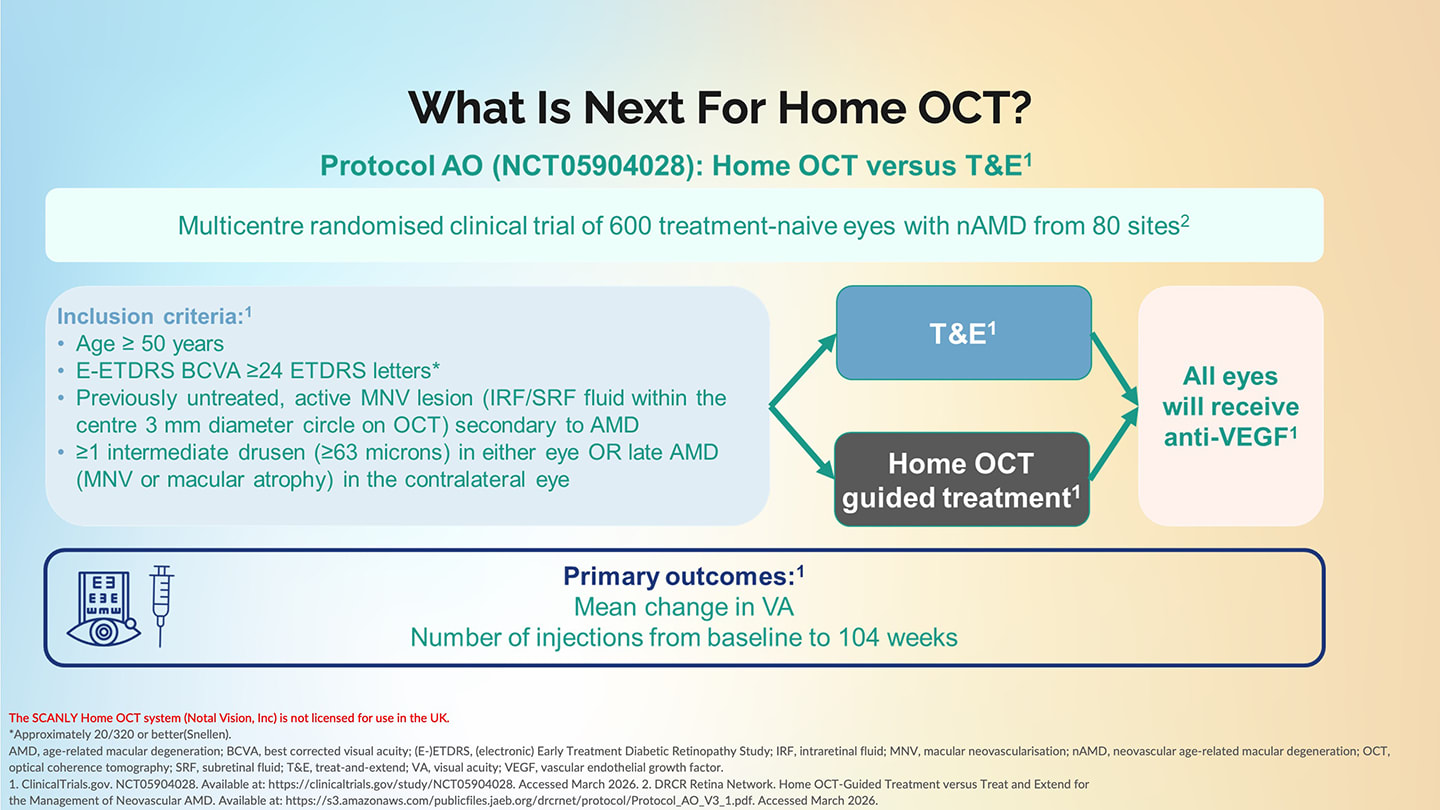
Figure 2. Protocol AO is a 600-patient DRCR Retina Network study comparing home OCT–guided management with standard treat-and-extend care in treatment-naïve neovascular AMD.
Looking ahead, Dr. Crawford discussed the role Protocol AO may play in defining how the technology performs in routine nAMD care (Figure 2). The study is comparing home OCT–guided management to standard treat-and-extend management in treatment-naïve eyes receiving anti-VEGF therapy. Primary endpoints include visual acuity outcomes and injection burden over 104 weeks.
For retina specialists considering integrating home OCT into practice, Dr. Crawford suggested the technology may be particularly valuable for highly anxious patients, those with extended treatment intervals, and patients fatigued by frequent office visits.
He emphasized that home OCT is intended to augment—not replace—clinical care by providing physicians and patients with an additional layer of monitoring and reassurance between visits. “With Home OCT, we have a safety net,” he said. “We can’t be there for every patient all the time, but let’s use the help when it’s given to us.” RP
References
1. Holekamp NM, de Beus AM, Clark WL, Heier JS. Prospective trial of home optical coherence tomography–guided management of treatment-experienced neovascular age-related macular degeneration patients. Retina. 2024;44(10):1714-1731. doi:10.1097/IAE.0000000000004167
2. Heier JS, Liu Y, Holekamp NM, et al. Clinical use of home OCT data to manage neovascular age-related macular degeneration. J Vitreoretin Dis. 2024;9(2):158-165. doi:10.1177/24741264241302858