





As retinal therapeutics become increasingly complex, the US Food and Drug Administration (FDA) continues to refine its approach to clinical evidence, trial design, and emerging regulatory pathways in ophthalmology, according to William M. Boyd, MD, director of the FDA's Division of Ophthalmology. Speaking virtually at Retina World Congress 2026 in Fort Lauderdale, Florida, Dr. Boyd addressed several emerging regulatory issues affecting ophthalmology sponsors and retina specialists. He also outlined new FDA initiatives relevant to drug development. Here are the key topics from his keynote lecture.
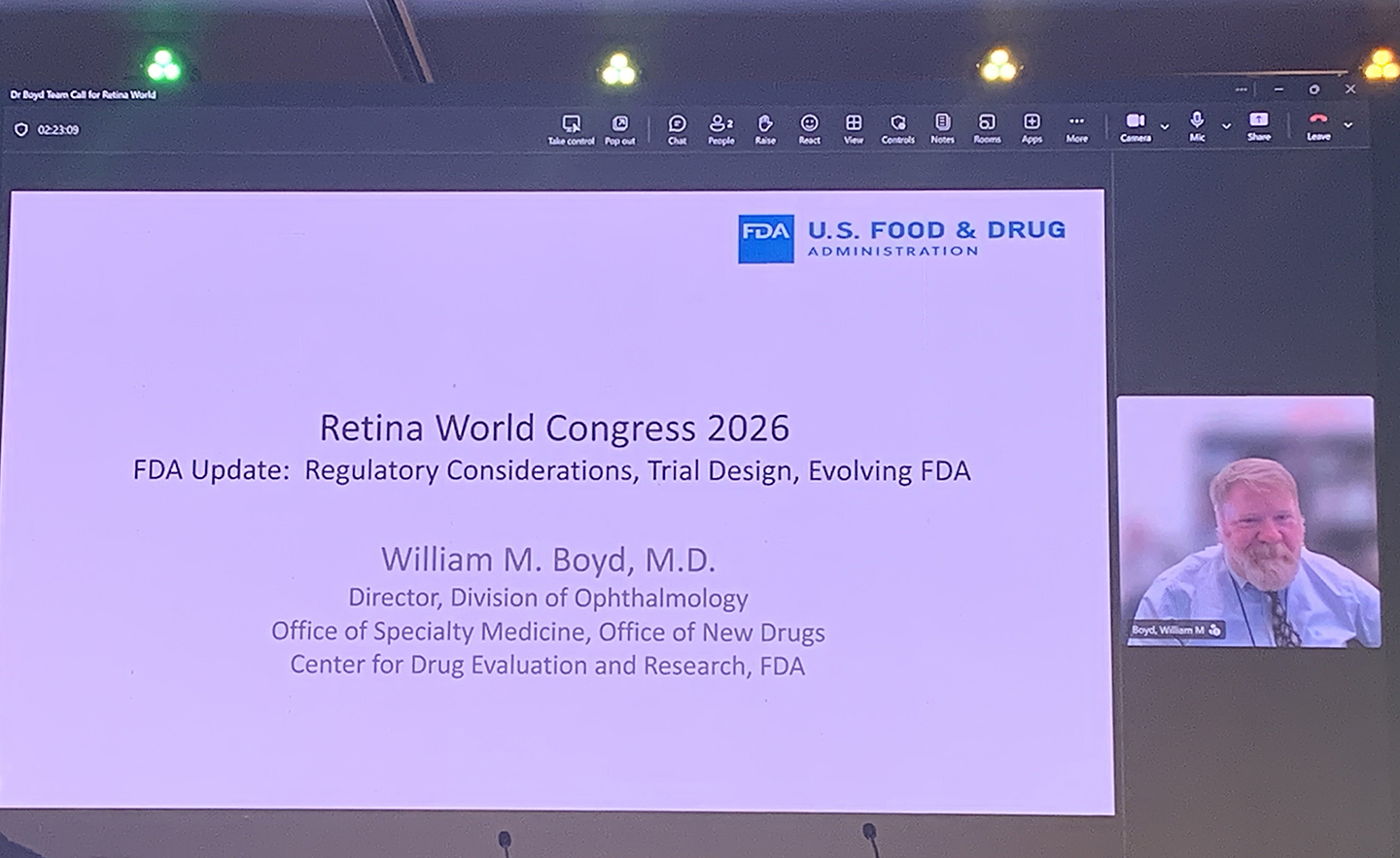
William M. Boyd, MD, spoke virtually at Retina World Congress 2026 on evolving FDA approaches to ophthalmology clinical trials, regulatory pathways, and drug development initiatives.
Sham injections in ophthalmology clinical trials. Dr. Boyd acknowledged concerns surrounding sham injections in retinal disease studies. “We do believe at the agency that the sham injections have the potential to introduce bias,” he said, adding that the FDA does not place trials on hold simply because they use sham procedures. Instead, he said the agency encourages sponsors to consider strategies such as multiple dosing levels and other trial design approaches to minimize bias as studies become increasingly complex.
Artificial intelligence. Dr. Boyd clarified that the FDA increasingly uses AI tools internally, but not as substitutes for scientific judgment. “My reviewers use it, but they do not use it to make their review decisions,” he said. “Instead, AI is being used to collate information, and then we discuss and make decisions.”
FDA’s Real-Time Clinical Trials program. The initiative would enable agency reviewers to access clinical trial data in near real time as case report form data are collected during active studies. According to Dr. Boyd, the approach is currently being evaluated in 2 oncology products, with the agency planning to publish pilot-program criteria and expand the effort following additional public feedback later this year.
Commissioner’s National Priority Voucher Pilot Program. This initiative is designed to significantly reduce review timelines for select drug and biologic applications that address innovative breakthrough therapies and large unmet medical needs. According to Dr. Boyd, it's meant for products that align with 1 of 5 critical national health priorities: emerging threats, innovative breakthrough therapies, large unmet medical needs, supply chain resilience, and affordability. “Under the pilot program, some review timelines could potentially be shortened to as little as 2 months,” he said, adding that not every product is necessarily eligible.
Single pivotal clinical trials. Dr. Boyd emphasized that the FDA’s evidentiary standards for drug approval “have not changed,” despite recent public discussion about the sufficiency of single pivotal trials. While single-trial approvals remain possible, he explained that such studies generally must be exceptionally large and statistically robust. “Typically, those trials are quite large—much larger than most ophthalmology trials—and they’re very robust, with P-values like 0.001,” said Dr. Boyd. He encouraged sponsors considering this pathway to engage the FDA early to determine whether their trial design could realistically support approval.
Newer FDA initiatives for rare and ultra-rare diseases. Dr. Boyd emphasized that these areas are increasingly important in retinal medicine. These include the FDA Rare Disease Innovation Hub, which coordinates efforts between the Center for Drug Evaluation and Research (CDER) and the Center for Biologics Evaluation and Research (CBER) to improve outcomes for patients with rare diseases, particularly where natural history is poorly understood, and patient populations are very small.
Another initiative is the Framework for Accelerated Development of Individualized Therapies for Ultra Rare Diseases, a draft guidance for sponsors seeking approval for targeted individualized therapies. “It’s meant for situations in which randomized controlled trials may be difficult or impossible because of very small patient populations,” said Dr. Boyd. “I think this is very interesting and exciting for some of our retinal ultra-rare diseases.” The key criteria are identifying the disease-causing abnormality and demonstrating that the therapy targets the root cause. “For traditional approval, therapies should demonstrate improvement in clinical outcomes, disease course, or biomarkers that predict clinical benefit,” he said.
Afterward, Dr. Boyd took questions from the audience. The following excerpt has been edited for length and clarity.
Q: Is the FDA considering whether phase 3 clinical trials could eventually be waived for ophthalmic biosimilars?
Dr. Boyd: The FDA is not yet at that point in ophthalmology. There is substantial internal discussion on the topic, and the agency recognizes the potential benefits of reducing unnecessary clinical trials. However, the FDA still considers clinical trial data highly valuable for confirming efficacy and safety and for informing product labeling. We understand the benefit of not needing a clinical trial if we were able to have satisfactory information from another method. We're just not there yet. As far as I’m aware, we are still requiring that single clinical trial to demonstrate the similarity of the product.
Q: What is the Special Protocol Assessment (SPA) process?
Dr. Boyd: The SPA is an official agreement between a sponsor and the FDA that the agency will accept a specific trial design and protocol for a particular drug indication. As long as there are no major changes in the science, completing that protocol would be highly supportive of your product's approval. We’re basically entering into an agreement before the trial is completed to accept your design, endpoints, and methodology. As you can imagine, we'll be very specific in our comments and feedback. If someone were to submit that request for evaluation, we would do that type of review within 45 days and issue a response. If we find anything missing or incomplete, you can resubmit the assessment.
Q: How does the FDA view intermediate age-related macular degeneration (AMD) as a treatment indication?
Dr. Boyd: We have not broken intermediate AMD out as a separate indication. It seems to be a gray area. We are happy to talk with individual sponsors about how they define intermediate AMD, what they want to demonstrate, and what endpoints they hope to evaluate. This is one of those areas where meeting with the agency is highly effective to ensure we understand what is being proposed.
Q: How closely does the FDA work with the European Medicines Agency (EMA)?
Dr. Boyd: We have routine scheduled conferences with our colleagues in Europe. When there are specific topics or when a company asks for alignment, we have discussions. There are occasionally differences in how the agencies interpret specific data or endpoints. For instance, the FDA has been very adamant that we do want to understand a true clinical benefit for the patient, not just a statistical change that can be demonstrated. RP