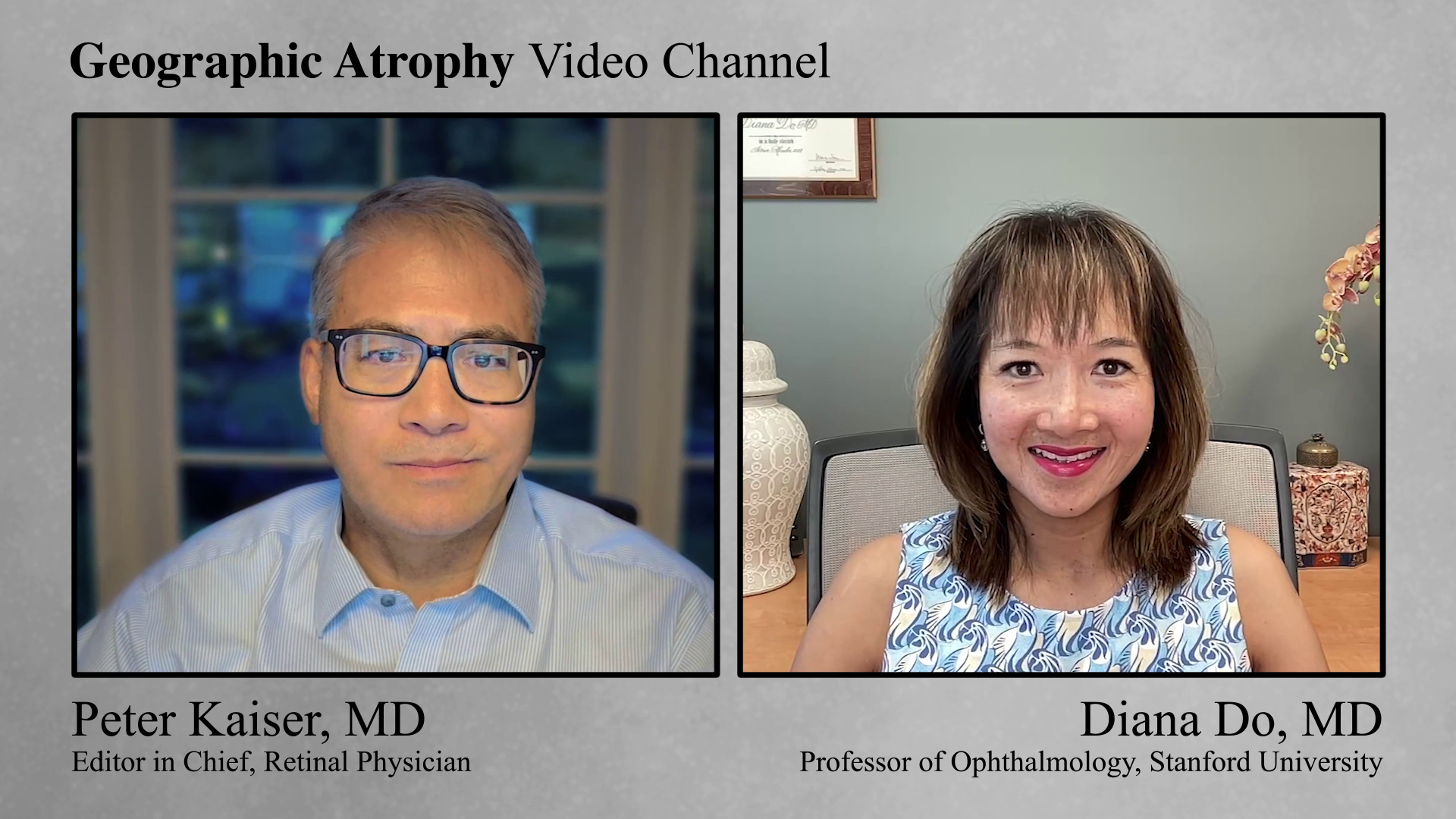


EPISODE 22: Diana Do, MD, interviews Esther Kim, MD, of Orange County Retina, about the importance of treating geographic early, and what she considers to be the indicators that it's time to act.
What follows is a slightly edited transcript of the conversation:
Diana Do, MD: Welcome to the Geographic Atrophy Video Channel. I'm Dr. Diana Do, and today I'm joined by a leading retina expert, Dr. Esther Kim. Welcome, Dr. Kim.
Esther Kim, MD: Thanks, Diana, for having me. It's a pleasure to be here.
Dr. Do: We have patients in our clinic who have geographic atrophy due to age-related macular degeneration, and for the past few years, we do have FDA-approved complement inhibitors. Do you utilize complement inhibitors in GA?
Dr. Kim: I do, and I use them fairly liberally. We were involved in the pivotal trials that led to their approval, and I think when you're involved from the ground up, there develops a familiarity with the product and a comfort with seeing a safety profile as the drug is in your hands. So I think that definitely enhances adoption earlier on for myself and also probably for my practice as a whole.
Dr. Do: A lot of us still have questions about when should we consider initiating complement inhibitors in GA? Do you utilize it in eyes with extrafoveal GA or only foveal-involving lesions? What is your practice pattern?
Dr. Kim: I err on treating earlier. I think there are those classic risk factors for patients who are faster progressive, like the multifocal lesions, extrafoveal, those with the banded hyper autofluorescence on FAF imaging, the multilobular lesions. There are those characteristics, certainly. I think when I see a patient, I don't really look so much at the exact surface area, there's no cutoff, but I think we've all seen that patient who is very unlucky and has a small little area, but it's right at the fovea and it's fovea involving or threatening the fovea. That's going to be a patient that you certainly want to act sooner on.
So, for me, there's no cutoff, but certainly I look at historical risk factors, how quickly it's progressed, but overall, my mentality is to treat sooner than later. And now that these drugs have been approved for several years, we have the data to back up that treating earlier does lead to overall greater saving of retinal tissue.
So for example, in the GALE studies, which was the 3-year, 36-month open-label extension of the 2-year OAKS and DERBY for pegcetacoplan, we can see when patients were crossed over to sham to active treatment versus those who were on sham from the outset, the patients who were on treatment from the beginning of the OAKS and DERBY, the 5 years of the study, they had more than 2 times the amount of retinal tissue saved in less than 2 times the amount of treatment duration. So that further underlies the notion that treating early certainly does lead to greater retinal tissue in a compound interest type of fashion. (Editor's note: an open-label extension trial for avacincaptad pegol showed increasing benefit over time in slowing GA lesion growth, with a reduction of 28.8% vs sham/projected sham. Read the results here.)
And I think now that there are other studies looking at deep learning and AI, we can further explore not only what we see on FAF, but also on ellipsoid zone level. And there was a recent paper by Justis Ehlers in Ophthalmology where you can see the amount of ellipsoid zone savings is in the 50% upwards for both avacincaptad pegol and pegcetacoplan. So I think certainly we know that what we're seeing on FAF is really just the tip of the iceberg. There's so much more going on where for me, I think treating earlier underscores the notion that we're able to slow down this otherwise devastating process sooner, and in the long run, preserve vision for longer for our patients.
Dr. Do: That evidence that you referenced is very compelling about the earlier treatment to save more of the retina. Another big question for retina specialists is how often should we be treating? Monthly seems to be most effective, but it is a burden for patients. What do you recommend?
Dr. Kim: We know that for pegcetacoplan it's approved every 4 to 8 weeks. For avacincaptad pegol, it's every 4 weeks. In my practice, I've been erring on 6 to 8 weeks for everyone, again, looking at those studies where they compare monthly to every other month dosing. I think while there is a slight benefit to those dosed monthly, the safety profile is much more favorable for those dosed every other month, so I tend to lean on 6 to 8 weeks, both in terms of reducing treatment burden, managing that side effect to benefit ratio to be maximally in the patient's favor.
Dr. Do: We really appreciate your insights and sharing all of your practical information about how you treat patients with GA. Thank you again, Esther, for joining us today.
Dr. Kim: Thanks so much for having me, Diana. Appreciate it.
Other Videos From Series