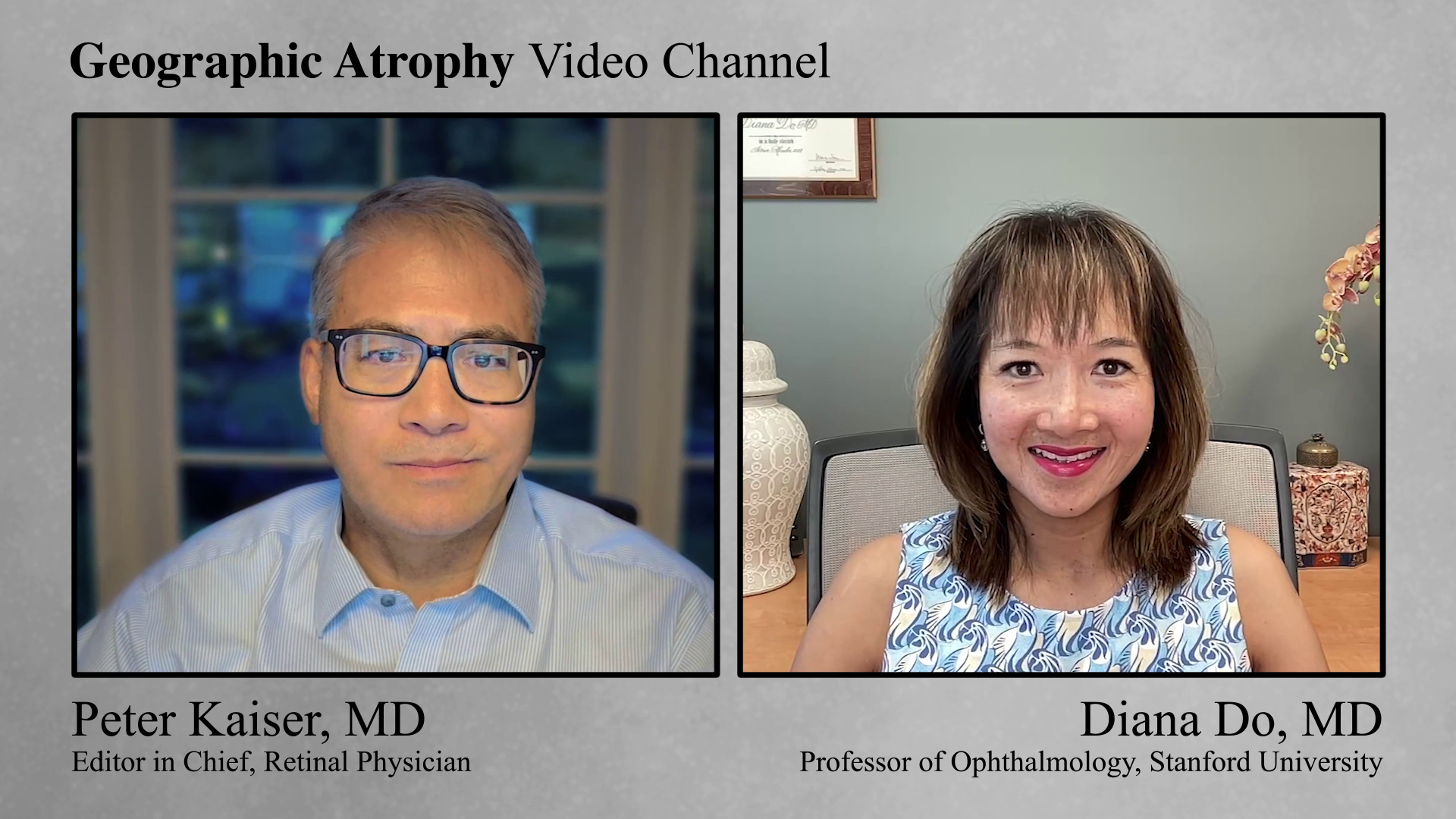


EPISODE 21: Dr. Diana Do interviews Christopher Riemann, MD, a retinal surgeon with the Cincinnati Eye Institute, about his management strategy for treating patients with GA, and how treatment has impacted the progression of the condition in his patients.
What follows is a lightly edited transcript of the conversation:
Diana Do. MD: Welcome to the Retinal Physician Geographic Atrophy Video Channel. I'm Dr. Diana Do, and today I'm joined by our expert guest, Dr. Christopher Riemann, who is going to discuss geographic atrophy (GA). Welcome, Chris.
Christopher Riemann, MD: Diana, great to be with you. Thank you.
Dr. Do: Tell me about how your perspective on treating eyes with GA has changed over the past 3 years now that we have FDA-approved therapies to try to slow down the progression of this disease. Tell me what your perspective is.
Dr. Riemann: Well, Diana, they call it the practice of medicine for a reason, and our priorities and our practice patterns are always evolving. The key change has been evolving from being able to offer these GA patients nothing except for vitamins and positive vibes to these GA patients to being able to offer them some hope. And it's really exciting and wonderful to be able to say to a GA patient, " I know I don't have a magic bullet that will make your GA go away, but I have something that we can use to slow down the progression of your disease until something better comes along." And then we can talk about some of the really exciting things that I talk about with the patients that are not approved yet and that are in the hopper for our patients.
Dr. Do: After you discuss the benefits and potential therapies that are available for GA now, how do you manage it? What is your treatment regimen? And how often do you perform imaging on eyes that are receiving complement inhibitors?
Dr. Riemann: Our clinics are full, especially here in the Midwest, and they're full of really severe disease. So for the past 20 years at the Cincinnati Eye Institute, I've had an embedded optometrist. It's exciting to be able to offer our GA patients something as opposed to nothing. But the reality is, if I've got 5 macular RDs in my waiting room and 3 PVRs and an open globe and a post-cataract surgery endophthalmitis, I choose not to take the time to have the carefully nuanced conversation that these patients deserve to decide whether or not they're going to get or not get anti-complement therapy for their GA. Because it is a nuanced conversation, and it's not for everyone because it's this broad biopsychosocial approach. Not everybody can come in and get 0.1 in their eye every month, because they're wheelchair bound and there's family logistic concerns and so on and so forth. Because of that, I have an embedded optometrist who has those conversations with them and also every 4 to 6 months does the dilated exam to make sure that there's no issues or problems.
In the absence of visual changes objectively or subjectively, I simply inject, but I don't do an exam. And then every 4 to 6 months, my optometrist does the exam for me. And obviously if there's complaints, well then I dilate, do an exam, and get testing. But in the absence of objective or subjective changes in vision, we inject and that's all we do.
Dr. Do: A lot of us are still observing eyes with GA and aren't sure whether or not to implement complement inhibitors. Have you seen GA progress quickly and has there been a difference when you've started complement inhibitors? How has that evolved over the past 3 years?
Dr. Riemann: I've had a few cases where I've actually traced it out. And early on with complement inhibitors, we had a cohort of patients that had clearly defined progression rates of their GA, where it's getting worse, getting worse, getting worse. Then we started complement inhibitors and you can see the slope change and it slows down. And then with some of the complement inhibitors, after a given period of time, insurance coverage was lost, so we stopped giving the treatment. And so it was rapidly progressing, then we gave treatment and then it slowed down, and then we stopped giving it because of insurance issues, and then it sped up and now that those insurance problems have been alleviated, we're able to give it again and it slowed down. So you can see, if you map it out and draw it out on the OCTs that these drugs do actually work. It's exciting.
Dr. Do: Well, thank you so much for sharing your insights about your real-world experience with complement inhibitors. I found it very educational and look forward to an update in the near future. Thank you, Christopher.
Dr. Riemann: Diana, thank you for the great questions. See you soon.