



Retina practices that perform large numbers of intravitreal injections (IVIs) must balance the need to reduce bacteria with the need to minimize treatment-related discomfort. A study presented at the 59th annual meeting of the Retina Society in Los Angeles suggests that 30 seconds of exposure to aqueous chlorhexidine gluconate 0.05% may be sufficient to achieve a significant reduction in conjunctival bacteria while providing a less-irritating alternative to povidone-iodine.
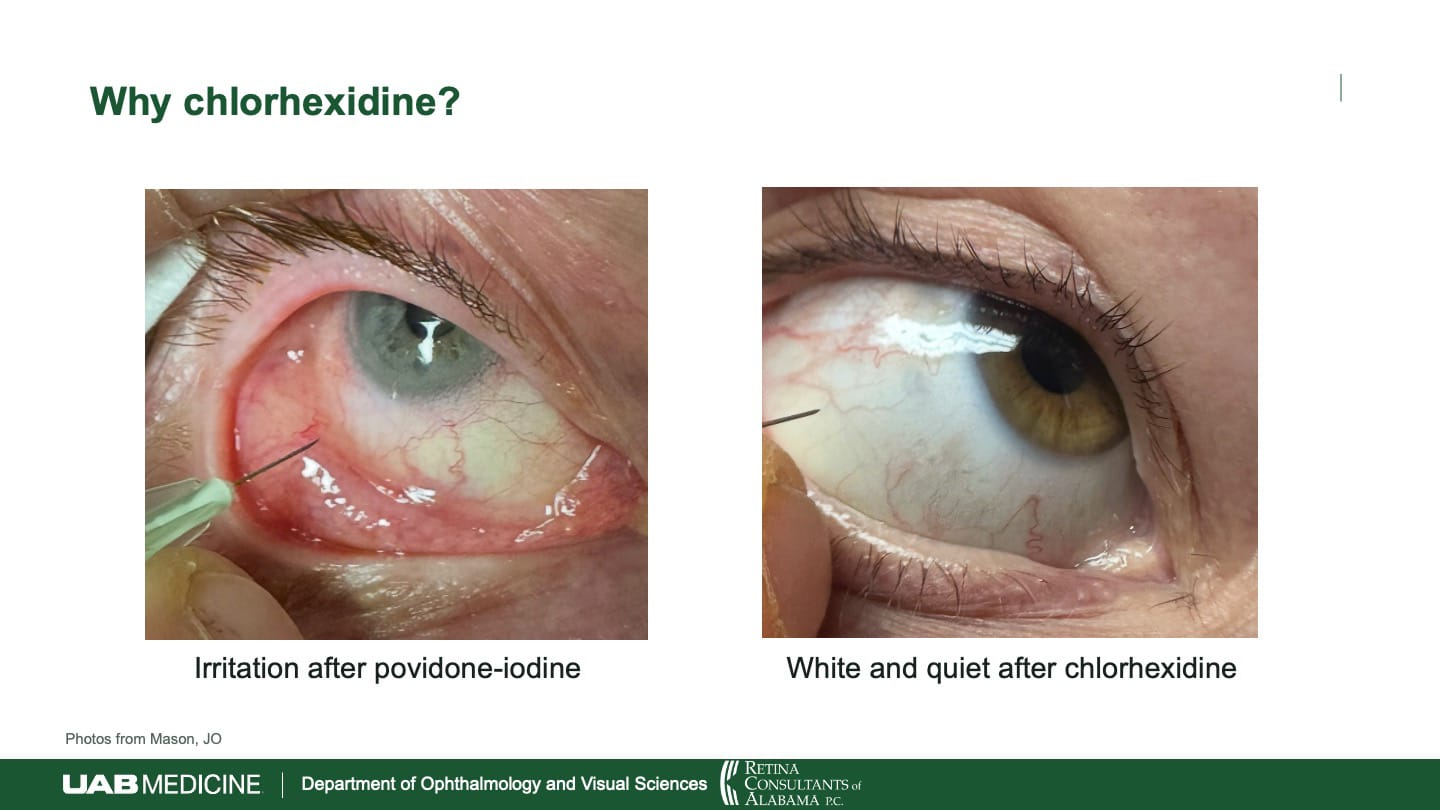
John O. Mason III, MD, a retina specialist at Retina Consultants of Alabama and director of the retina service, retina fellowship, and ocular oncology at the University of Alabama at Birmingham, noted that although 5% povidone-iodine remains the standard for antisepsis before IVI,1 its effectiveness comes with drawbacks. Previous studies have found that aqueous chlorhexidine may cause less ocular discomfort and corneal epitheliopathy than povidone-iodine, he said, while being similarly effective at reducing conjunctival bacteria (Figure 1).2,3
In the prospective, randomized study of 122 eyes of 72 patients presented at the meeting, investigators compared 30-second, 60-second, and 90-second exposure times to 0.05% aqueous chlorhexidine before IVI. Conjunctival cultures were obtained before antisepsis and again after treatment, with samples cultured on sheep blood agar for 5 days, to assess changes in bacterial load.
Culture positivity decreased from 67.5% to 12.5% in the 30-second group, from 70% to 15% in the 60-second group, and from 71.4% to 14.3% in the 90-second group. Each within-group reduction was statistically significant (P<.001), said Dr. Mason.
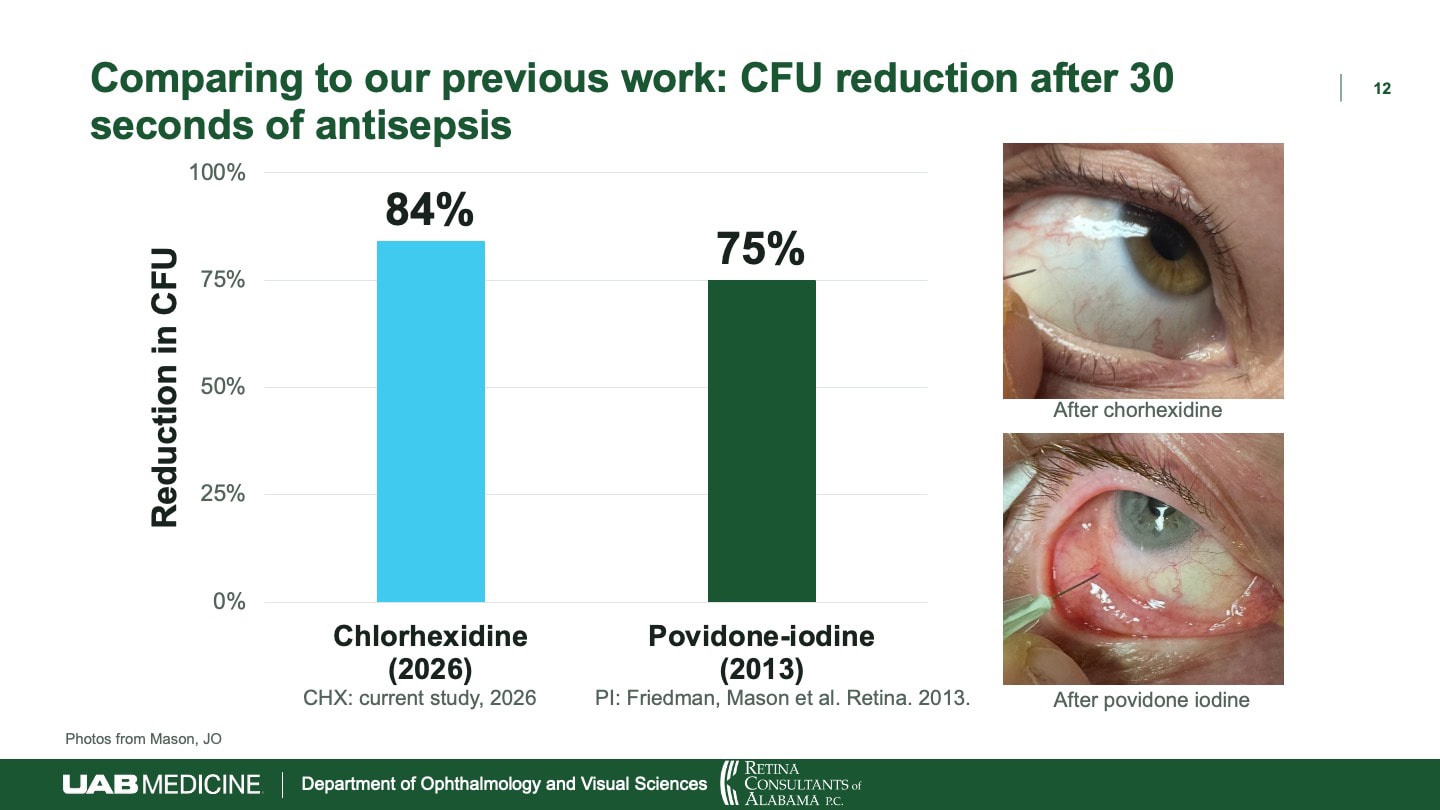
When investigators counted individual colony-forming units (CFUs)—“Yes, we actually counted every colony,” said Dr. Mason —reductions were similar across groups: 84.1% at 30 seconds, 85.2% at 60 seconds, and 84.5% at 90 seconds. This was superior to the 75% CFU reduction reported in his group’s 2013 study of povidone-iodine (Figure 2).4 No infectious endophthalmitis, corneal toxicity, allergic reactions, or other adverse events were observed.
Dr. Mason concluded that the findings support a standardized 30-second exposure protocol for 0.05% aqueous chlorhexidine before IVI. RP
References
1. Wykoff CC, Flynn HW Jr, Rosenfeld PJ. Prophylaxis for endophthalmitis following intravitreal injection: antisepsis and antibiotics. Am J Ophthalmol. 2011;152(5):717-9.e2. doi:10.1016/j.ajo.2011.07.002
2. Ali FS, Jenkins TL, Boparai RS, et al. Aqueous chlorhexidine compared with povidone-iodine as ocular antisepsis before intravitreal injection: a randomized clinical trial. Ophthalmol Retina. 2021;5(8):788-796. doi:10.1016/j.oret.2020.11.008
3. Ton NS, Goncharov V, Zapata I, Adam MK. Endophthalmitis after anti-VEGF intravitreal injections with aqueous chlorhexidine versus povidone-iodine as ocular antiseptics. Ophthalmol Retina. 2024;8(6):521-526. doi:10.1016/j.oret.2023.12.004
4. Friedman DA, Mason JO 3rd, Emond T, McGwin G Jr. Povidone-iodine contact time and lid speculum use during intravitreal injection. Retina. 2013;33(5):975-981. doi:10.1097/IAE.0b013e3182877585