


The following transcript has been edited for clarity.
Hi, I’m Ferhina S. Ali, MD. I’m a retina specialist practicing in Westchester at New York Medical College and Westchester Medical Center. I’ll be at the ARVO meeting in Denver presenting 2-year data from the FARETINA age-related macular degeneration (AMD) study.
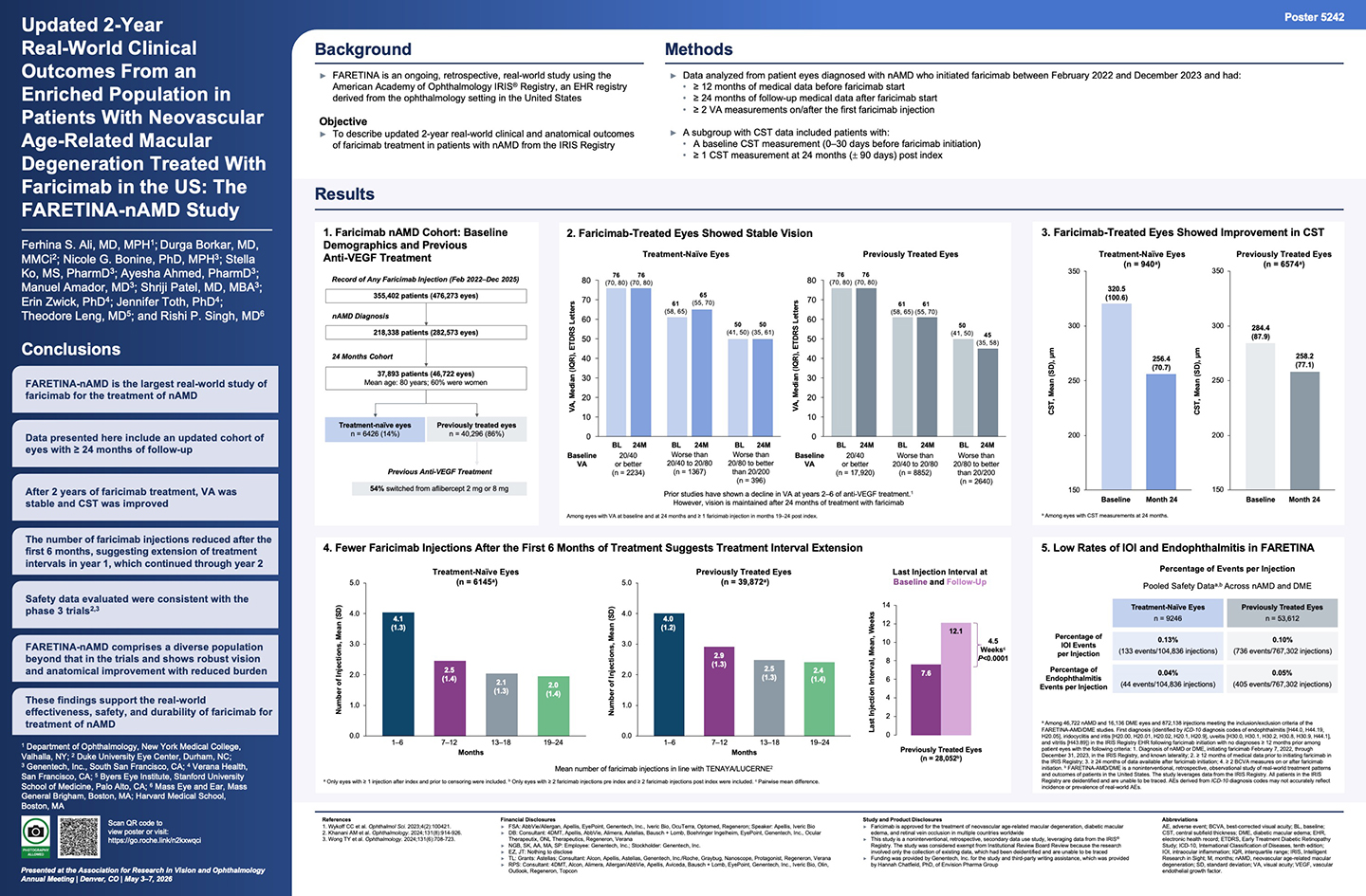
FARETINA is an ongoing, retrospective, real-world study using the American Academy of Ophthalmology’s IRIS Registry, an EHR-derived registry of ophthalmology patients in the United States. In this study, we evaluated 2-year real-world clinical and anatomic outcomes in faricimab-treated patients with wet AMD. These data were analyzed from eyes diagnosed with neovascular AMD that initiated faricimab (Vabysmo; Genentech) soon after it became available, from February 2022 through December 2023, as their first injection.
Patients included in this analysis had at least 1 year of data prior to initiating faricimab within the registry and at least 2 years of follow-up, allowing for a 2-year analysis. We were also interested in visual and anatomic outcomes, so we required sufficient data to assess vision and anatomy during treatment.
This 2-year cohort included nearly 6,500 treatment-naïve eyes and 40,000 previously treated eyes. More than 50% of previously treated eyes had received aflibercept, either 2 mg (Eylea; Regeneron) or 8 mg (Eylea HD). At a high level, we found that over 2 years, these patients maintained stable vision while undergoing treatment with faricimab, both in treatment-naive and previously treated groups. In terms of anatomy, we also observed anatomic improvement in both groups.
These are important findings that are consistent with what has been seen in clinical trials and are reassuring in a real-world setting.
We were also interested in durability. Clinical trials provide some data, but it is important to understand how these agents perform in broader patient populations. Over each year of the 24-month period, we observed that patients required an average of 4 to 5 injections early in the first year, followed by a reduction in the number of injections in the latter half of the year. This suggests that treatment intervals were extended after the initial treatment period. This reduction, first observed in the latter 6 months of year 1, persisted through the 2-year cohort.
We also evaluated the last injection interval in previously treated patients. We observed an increase of approximately 4 to 5 weeks on average after switching to faricimab. So, we're reassured by these findings in terms of treatment efficacy, as well as treatment durability with this 2-year neovascular AMD cohort.
Of course, we're always going to be interested in safety. What we saw is that the safety profile was really reassuring in terms of rates of endophthalmitis that we might expect in very large cohorts; low rates of much, much less than 0.1% even in our treatment-naive and previously treated eyes. Rates of intraocular inflammation were also low, at less than 0.5%, really 0.1% in both groups. So, the safety data was also very reassuring.
Overall, the FARETINA neovascular AMD study includes a diverse, real-world population from the IRIS Registry, capturing patients beyond those typically enrolled in clinical trials. Overall, we observed stable vision, anatomic improvement, and reduced treatment burden in this real-world cohort, overall supporting the effectiveness, safety, and durability of faricimab treatment for neovascular AMD. I look forward to sharing those results soon after the meeting. Thank you. RP