

The following transcript has been edited for clarity.
Hello everyone. I'm Robert P. Finger, MD, PhD, from the University of Heidelberg in Germany. I’m currently at the ARVO conference, where I presented data from the ongoing VOYAGER study, which is a Roche-sponsored noninterventional post-marketing study of faricimab (Vabysmo; Genentech/Roche) for all of its approved indications. It is run across 28 countries and has included more than 5,000 participants who are followed up for at least 2 years.
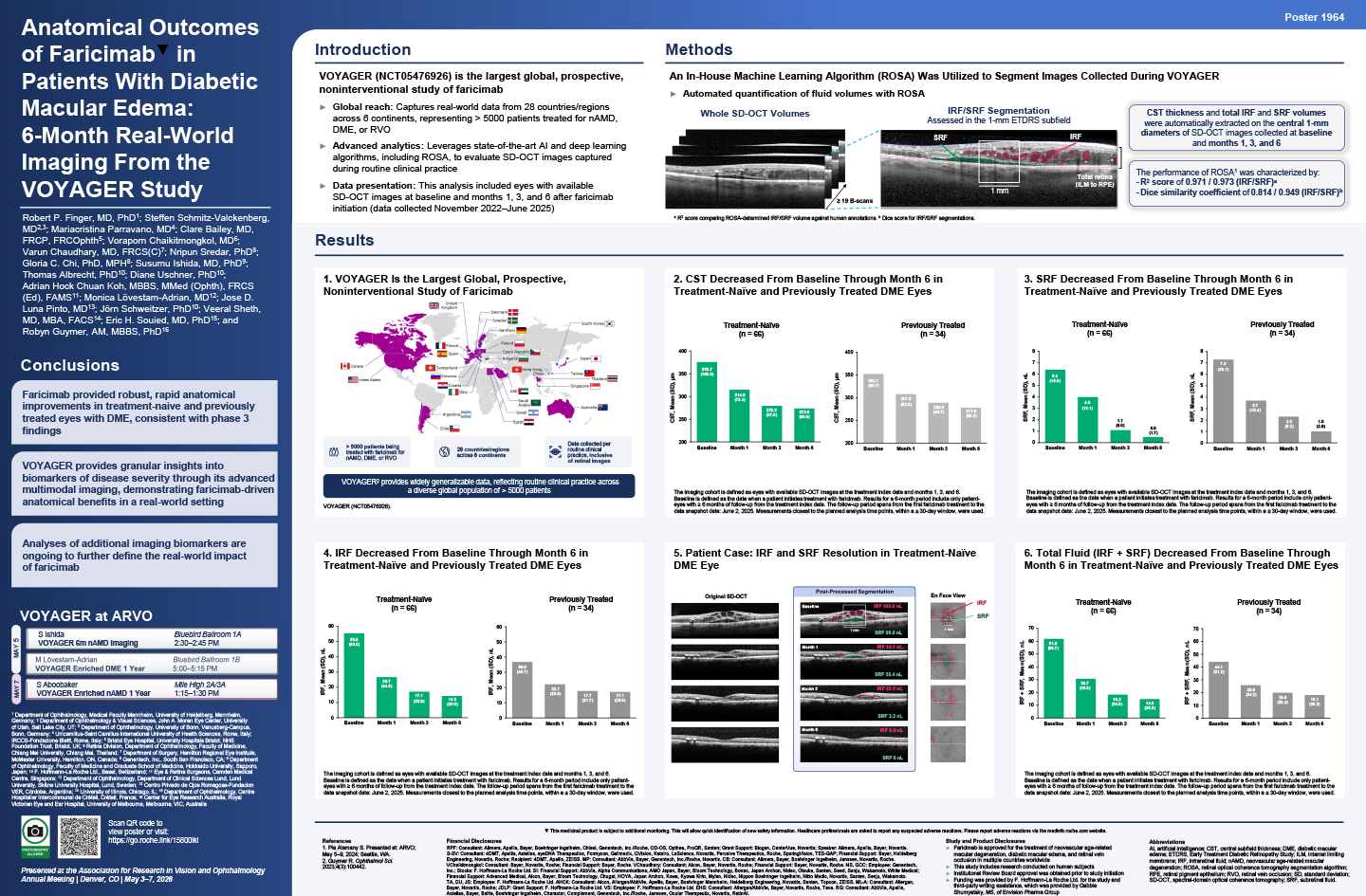
As part of the data collection, the VOYAGER study also collected imaging data, which is unusual for a noninterventional post-marketing study. But because there's a lot of imaging data, it has to be analyzed nonmanually, using, of course, AI-based algorithms. Roche developed ROSA, which is used for volumetric analysis. It can detect and quantify fluid in and under the retina, which is very relevant for diabetic macular edema (DME), which I presented on.
In a subset of the participants for which we had all the data necessary for ROSA to function and derive outputs, we analyzed intraretinal and subretinal fluid as well as total retinal fluid at baseline month 1, 3, and 6. This is the data that I presented today. It shows beautifully that in the real world, faricimab leads—similar to the randomized controlled trials (RCTs)—to a very quick reduction in fluid, which is already measurable at month 1 with the ROSA algorithm. For intraretinal fluid, it halved the intraretinal fluid—more than half, actually—at month 1. And for subretinal fluid, it took a little longer, but it brought it down to almost zero at month 6 in the subgroup of patients that we looked at for this analysis. So this is very encouraging, and as it's an ongoing study, there will be more presented with time.
And there's also a few other presentations on VOYAGER at this conference, so there will be a lot of papers to read up on this. So we're looking forward to more real-world data on faricimab in DME, and also, of course, in neovascular AMD.
But today it was about DME, where the ROSA algorithm, works really well. Thank you all for listening to this. RP