



The introduction of anti-VEGF agents in 2004 completely changed treatment paradigms for vascular retinal conditions, including neovascular age-related macular degeneration (nAMD) and diabetic macular edema (DME). Although efficacy for patients has been unparalleled, these agents place a substantial burden on the health care system, patients, and physicians. Ongoing research has led to the development of newer agents aimed at improving visual outcomes while reducing injection frequency and overall treatment burden. One class of agents under investigation for this purpose is tyrosine kinase inhibitors (TKIs).
Current anti-VEGF agents include monoclonal antibodies targeting all isoforms of VEGF-A (ranibizumab, bevacizumab, and brolucizumab); a decoy receptor that binds VEGF-A, VEGF-B, and placental growth factor (aflibercept); and a bispecific antibody that binds both VEGF-A and angiopoietin-2 (faricimab).1 In contrast, tyrosine kinases are signal transduction enzymes involved in numerous metabolic pathways (Figure 1).

Figure 1. Schematic representation of key angiogenic and growth factor signaling pathways targeted in ophthalmology by anti-VEGF agents and tyrosine kinase inhibitors (TKIs). TKIs have a broad range of targets, which may lead to increased duration of action.
Kinases are classified into 3 main categories: receptor tyrosine kinases (RTKs), nonreceptor tyrosine kinases, and dual-specificity kinases. RTKs consist of 2 domains: an extracellular domain that binds specific ligands and an intracellular domain involved in phosphorylation. Phosphorylation of protein amino acids leads to downstream signaling and activation or inhibition of metabolic pathways.1,2
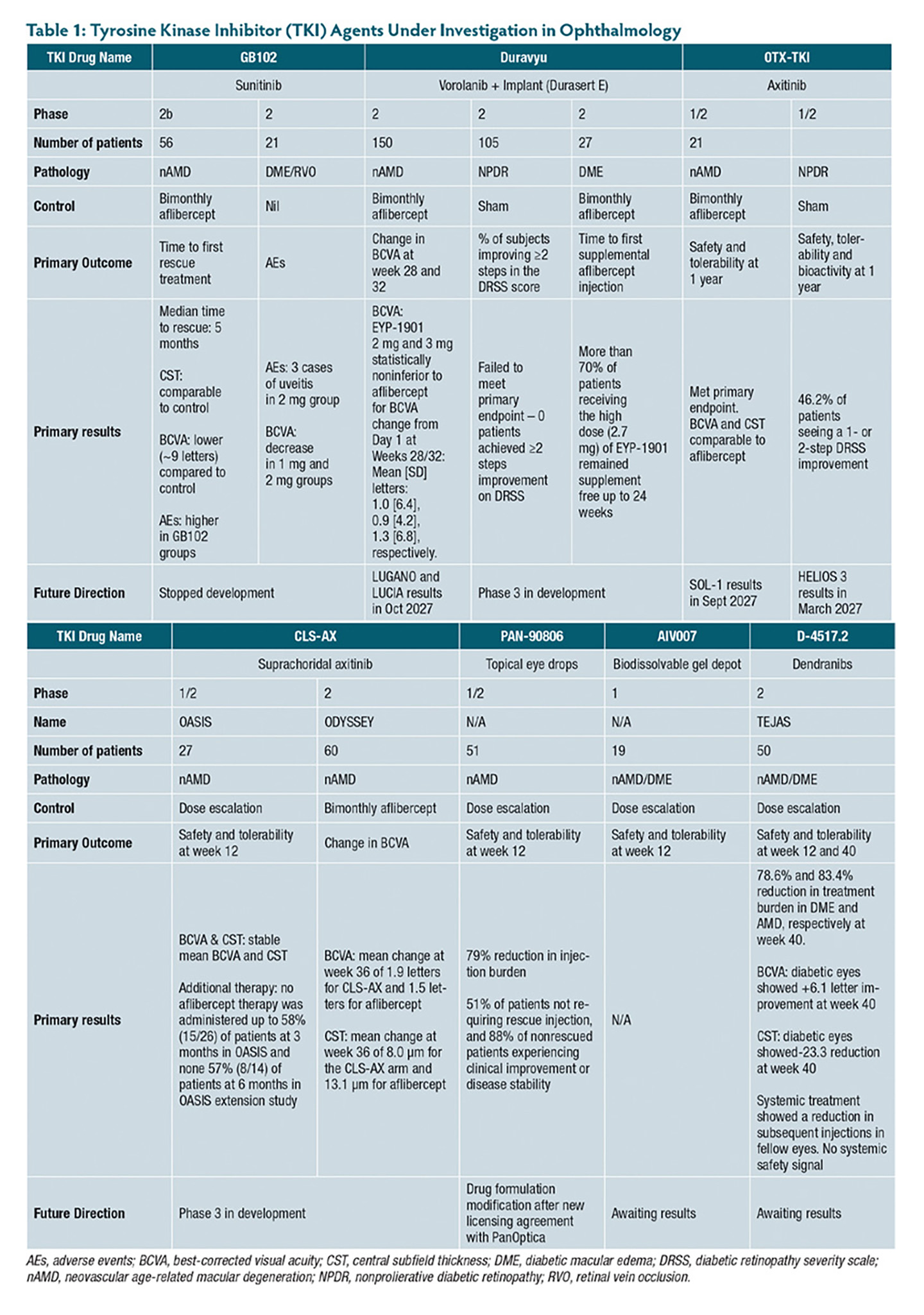
At present, no TKIs are commercially available; however, several agents are in clinical trials for nAMD and DME. Multiple routes of administration are being studied, including intravitreal, suprachoroidal, subcutaneous, and topical delivery. These agents and key clinical trial findings are summarized in Table 1.
Vorolanib
Vorolanib is a nonselective TKI that inhibits VEGFR, FGFR, PDGFR, FLT3, c-KIT, and RET.1 An oral formulation (X-82) was previously studied but discontinued due to high rates of systemic liver toxicity and ocular adverse events (AEs).3 Duravyu (EYP-1901; EyePoint Pharmaceuticals) was subsequently developed as a combination of vorolanib and the Durasert E bioerodible implant. This sustained-release system is injected in the office and allows for high drug loading, with zero-order release kinetics over approximately 6 to 9 months.1
The phase 2 DAVIO 2 trial in nAMD demonstrated statistically noninferior best-corrected visual acuity (BCVA) outcomes compared with aflibercept at weeks 28 and 32. Results from the phase 3 LUGANO and LUCIA trials are expected in October 2027.4 In DME, the phase 2 VERONA trial met primary and secondary endpoints with favorable BCVA, anatomical improvements, and reduced treatment burden.5 According to the company, phase 3 trials in DME and diabetic retinopathy (DR) are in development.
Axitinib
Axitinib is a highly selective inhibitor of VEGF and platelet-derived growth factor receptors, with high affinity and relatively low solubility compared with other ocular TKIs.6 OTX-TKI (Axpaxli) is an intravitreal, bioerodible hydrogel implant containing axitinib, developed by Ocular Therapeutix. Phase 1/2 trials met primary endpoints in both nAMD and DME. In nAMD, BCVA and central subfield thickness (CST) outcomes were comparable with aflibercept. In DME, the HELIOS phase 1/2 trial showed that 46.2% of patients achieved a 1-step or 2-step improvement on the Diabetic Retinopathy Severity Scale (DRSS).7
Axpaxli is currently being evaluated for nAMD in a pair of phase 3 trials. SOL-1 is a superiority trial designed under a special protocol assessment with the US Food and Drug Administration (FDA). Top-line results from SOL-1 were presented at the Macula Society meeting in March 2026. SOL-R is a registration trial, with top-line data expected in 2027. The implant is also being studied in the phase 3 HELIOS 3 trial, with results anticipated in March 2027.8
CLS-AX is an injectable axitinib suspension for suprachoroidal delivery developed by Clearside Biomedical and administered using the company’s proprietary suprachoroidal space (SCS) microinjector. This approach compartmentalizes drug delivery, limiting exposure to nondiseased tissues while increasing bioavailability and durability.9,10 In the phase 1/2 OASIS trial, mean BCVA and CST remained stable across escalating doses, and no additional aflibercept therapy was required in 58% (15/26) of patients at 3 months and 57% (8/14) at 6 months in the extension study. The phase 2 ODYSSEY trial met its primary endpoint, with mean BCVA changes at week 36 of +1.9 letters for CLS-AX and +1.5 letters for aflibercept. Mean CST reductions were 8.0 µm and 13.1 µm, respectively.11-13
PAN-90806
PAN-90806 is a topical TKI eye drop for nAMD developed by Zhaoke Ophthalmology. Early phase 1/2 trials identified punctate keratopathy as a potential AE, prompting development of a new formulation. This formulation was evaluated in a phase 1/2 trial of once-daily dosing for 12 weeks in 51 treatment-naïve patients with nAMD. Results demonstrated a 79% reduction in injection burden, with 51% of patients not requiring rescue injections and 88% of nonrescued patients experiencing clinical improvement or disease stability. PanOptica has since entered into a licensing agreement with Zhaoke Ophthalmology to further optimize the formulation.14
AIV007
AIV007 is an injectable, broad-spectrum TKI developed by AiViva BioPharma that transitions to a biodissolvable gel depot at body temperature, enabling prolonged drug release. A phase 1 trial enrolled 19 patients with DME or nAMD who received a single periocular injection and were followed monthly for up to 6 months. One low-dose, 4 intermediate-dose, and a high-dose formulation were evaluated. The study is estimated to be completed in April 2025; results have not yet been reported.15,16
Dendranibs
D4517.2 (migaldendranib) is the first agent in a novel class of TKIs known as dendranibs, developed by Ashvattha Therapeutics. It selectively inhibits VEGF receptor tyrosine kinases in activated microglia, macrophages, and hypertrophic retinal pigment epithelial cells. Oral and subcutaneous routes are under investigation. Oral dosing in mouse models has demonstrated reductions in choroidal neovascularization lesion size comparable with subcutaneous administration.
The phase 2 TEJAS study evaluated escalating monthly subcutaneous doses of D4517.2 compared with aflibercept in previously treated patients with nAMD and DME. The 40-week study demonstrated reductions in treatment burden of 78.6% in DME and 83.4% in nAMD. As a systemic therapy, reductions in injection requirements were also observed in fellow eyes. At week 40, eyes with diabetes showed a mean BCVA improvement of +6.1 letters and a mean CST reduction of 23.3 µm. No systemic safety signals were observed.14,17-18
Safety and Challenges
Rates of ocular AEs in TKI trials have generally been comparable with those observed in other anti-VEGF injection studies, supporting a favorable safety profile. A notable exception is GB102 (sunitinib), a sustained-release TKI developed by GrayBug Vision and delivered via intravitreal injection. Sunitinib is a nonselective inhibitor of RTKs, including VEGFR1-3, FGFR1-3, and PDGFR-α and PDGFR-β isoforms. Phase 2 trials in nAMD and DME demonstrated reduced BCVA, which was attributed to product dispersion in the vitreous, as well as increased AEs compared with aflibercept. Development was discontinued in 2022.19 PAN-90806 also demonstrated safety concerns in early trials and is undergoing reformulation.14 Whether these modifications will meaningfully alter safety or efficacy remains to be determined.
Conclusion
Anti-VEGF therapies have revolutionized the management of nAMD and diabetic eye disease but are associated with a substantial and ongoing treatment burden. TKIs represent a promising next step by targeting multiple angiogenic and inflammatory pathways and by leveraging delivery platforms designed to extend durability. A diverse pipeline of TKIs, including intravitreal, suprachoroidal, topical, and subcutaneous formulations, has demonstrated encouraging signals of efficacy, noninferiority to established anti-VEGF agents, and the potential to reduce injection frequency.
Important questions remain. Not all agents have demonstrated favorable safety or efficacy profiles, highlighting the need for careful target selection, optimized formulations, and appropriate routes of administration. Although ongoing phase 3 trials are designed to support regulatory approval, their protocols may not fully reflect real-world clinical practice, where clinicians typically do not allow substantial vision loss or persistent fluid before rescue therapy. Postapproval clinical experience will be critical in determining whether TKIs can deliver consistent visual outcomes while safely reducing treatment burden. If successful, TKIs may ultimately complement—or, in select cases, provide alternatives to—current anti-VEGF therapies, offering a more sustainable long-term approach for patients and health care systems. RP


References
1. Chandra S, Tan EY, Empeslidis T, Sivaprasad S. Tyrosine Kinase Inhibitors and their role in treating neovascular age-related macular degeneration and diabetic macular oedema. Eye (Lond). 2023;37(18):3725-3733. doi:10.1038/s41433-023-02610-z
2. Thomson RJ, Moshirfar M, Ronquillo Y. Tyrosine Kinase Inhibitors. In: StatPearls. StatPearls Publishing; 2025. http://www.ncbi.nlm.nih.gov/books/NBK563322/
3. Cohen MN, O’Shaughnessy D, Fisher K, et al. APEX: a phase II randomised clinical trial evaluating the safety and preliminary efficacy of oral X-82 to treat exudative age-related macular degeneration. Br J Ophthalmol. 2021;105(5):716-722. doi:10.1136/bjophthalmol-2020-316511
4. Patel N, Ribeiro R. LUGANO and LUCIA trial design: pivotal phase 3 studies of EYP-1901 vs aflibercept in wet age-related macular degeneration. Invest Ophthalmol Vis Sci. 2025;66(8):692-692.
5. Modi Y, et al. How vorolanib could shift the DME landscape. Retinal Physician. June 1, 2025. Accessed February 4, 2026. https://www.retinalphysician.com/issues/2025/june/clinical-trial-download/
6. Zhao Y, Adjei AA. Targeting angiogenesis in cancer therapy: moving beyond vascular endothelial growth factor. Oncologist. 2015;20(6):660-673. doi:10.1634/theoncologist.2014-0465
7. Barakat MR, Brown D, Hu A, et al. Safety and tolerability of suprachoroidal axitinib injectable suspension, for neovascular age-related macular degeneration; phase I/IIa open-label, dose-escalation trial. Ophthalmol Sci. 2025;5(1):100586. doi:10.1016/j.xops.2024.100586
8. Axpaxli trial reaches enrollment target. Retinal Physician. November 4, 2025. Accessed February 4, 2026. https://www.retinalphysician.com/news/2025/axpaxli-trial-reaches-enrollment-target/
9. Lampen SIR, Khurana RN, Noronha G, Brown DM, Wykoff CC. Suprachoroidal space alterations following delivery of triamcinolone acetonide: post hoc analysis of the phase 1/2 HULK study of patients with diabetic macular edema. Ophthalmic Surg Lasers Imaging Retina. 2018;49(9):692-697. doi:10.3928/23258160-20180831-07
10. Moisseiev E, Loewenstein A, Yiu G. The suprachoroidal space: from potential space to a space with potential. Clin Ophthalmol. 2016;10:173-178. doi:10.2147/OPTH.S89784
11. Clearside Biomedical announces positive 6-month results from OASIS extension study with suprachoroidal CLS-AX (axitinib injectable suspension) in wet AMD. February 2, 2023. Accessed February 4, 2026. https://ir.clearsidebio.com/news-releases/news-release-details/clearside-biomedical-announces-positive-6-month-results-oasis
12. Hutton D. Clearside Biomedical unveils positive topline results from ODYSSEY phase 2b trial of suprachoroidal CLS-AX in wet AMD. Ophthalmology Times. October 9, 2024. Accessed February 4, 2026. https://www.ophthalmologytimes.com/view/clearside-biomedical-unveils-positive-topline-results-from-odyssey-phase-2b-trial-of-suprachoroidal-cls-ax-in-wet-amd
13. Wang R, Chong V, Fisher N. Top line results from ODYSSEY: a phase 2b study of suprachoroidally administered CLS-AX in participants with neovascular age-related macular degeneration. Invest Ophthalmol Vis Sci. 2025;66(8):6279-6279.
14. Saeed O, Sheth V. The promise of TKIs. Retinal Physician. April 1, 2025. Accessed February 4, 2026. https://www.retinalphysician.com/issues/2025/april/the-promise-of-tkis/
15. A phase 1 study of the safety, pharmacokinetics, and exploratory efficacy of periocular administration of AIV007 in subjects with macular edema secondary to neovascular age-related macular degeneration (nAMD) or diabetic macular edema (DME). clinicaltrials.gov identifier: NCT05698329. Updated March 6, 2025. Accessed February 4, 2026. https://clinicaltrials.gov/study/NCT05698329
16. AiViva Biopharma completes enrollment in phase 1 trial of AIV007 for wet AMD and DME. BioPharma APAC. August 26, 2024. Accessed February 4, 2026. https://biopharmaapac.com/news/50/5172/aiviva-biopharma-completes-enrollment-in-phase-1-trial-of-aiv007-for-wet-amd-and-dme.html
17. Safety, Tolerability and PK of Subcutaneous D-4517.2 in Subjects With Wet AMD or DME (Tejas). Clinicaltrials.gov identifier: NCT05387837. Updated May 4, 2025. Accessed February 4, 2026. https://clinicaltrials.gov/study/NCT05387837
18. Ashvattha Therapeutics announces first patient dosed via subcutaneous administration of anti-angiogenic therapeutic D-4517.2 for wet AMD and DME in phase 2 chronic dosing study. November 9, 2023. Accessed February 4, 2026. https://avttx.com/ashvattha-therapeutics-announces-first-patient-dosed-via-subcutaneous-administration-of-anti-angiogenic-therapeutic-d-4517-2-for-wet-amd-and-dme-in-phase-2-chronic-dosing-study/
19. Said RB, Xu T, Bakri SJ. A review of tyrosine kinase inhibitors. Review of Ophthalmology. September 10, 2024. Accessed February 4, 2026. https://www.reviewofophthalmology.com/article/a-review-of-tyrosine-kinase-inhibitors