

In a small retrospective study of patients with neovascular age-related macular degeneration (nAMD) and coexisting epiretinal membrane (ERM), removal of the membrane was associated with a significant reduction in anti-VEGF injection burden.
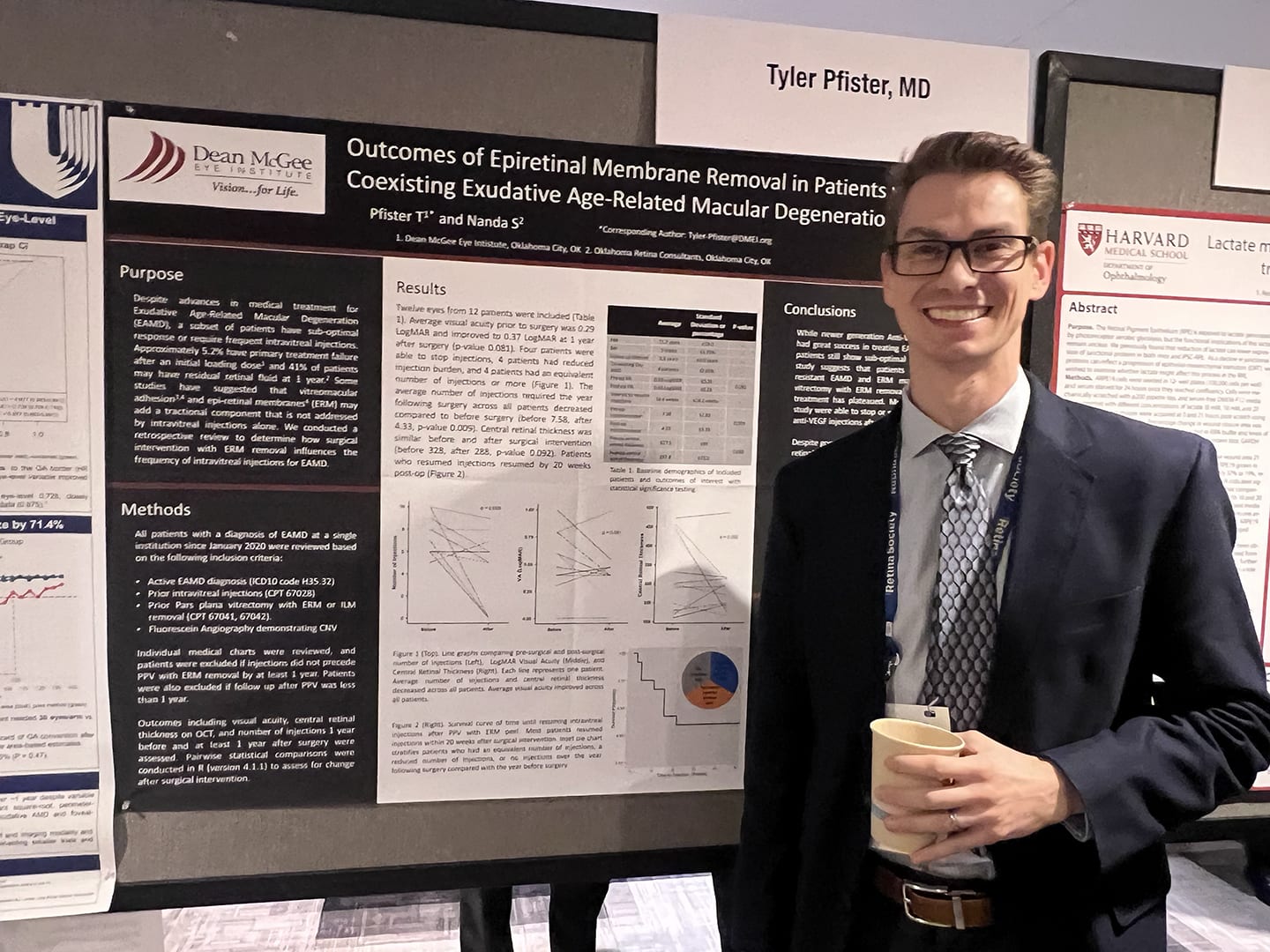
Tyler Pfister, MD, of Dean McGee Eye Institute in Oklahoma City, presented the findings during Thursday’s poster session at the 59th annual meeting of the Retina Society in Los Angeles. Dr. Pfister and coauthor Sumit Nanda, MD, evaluated 12 eyes of 12 patients who had received intravitreal injections for at least a year before undergoing pars plana vitrectomy with ERM removal. The investigators examined this approach because ERMs may contribute to cystoid macular edema that persists despite anti-VEGF therapy.
The mean number of injections declined from 7.58 in the year before surgery to 4.33 in the year afterward (P=.009). Four patients stopped injections, 4 had a reduced injection burden, and 4 required an equivalent or greater number. Among patients who resumed injections, the mean time to resumption was 16.4 weeks, according to the poster.
Central retinal thickness decreased from approximately 328 μm before surgery to 288 μm afterward, but the difference was not statistically significant (P=.092). Visual acuity also did not change significantly (P=.081).
The findings suggest that patients with treatment-resistant nAMD and coexisting ERM may experience reduced anti-VEGF treatment burden following vitrectomy with ERM removal. The investigators noted that their study was limited by its small sample size and treatment by a single provider at a single site and said that further studies are needed to better determine the potential benefit of surgery in this population. RP