

Earlier this year, I sat down with the chief clinical operations officer of the sponsor behind the first phase 3 study I ran as principal investigator (PI) after joining my current practice as director of research. She had our report card in front of her. I knew the first part: We were the top recruiting site. What I did not expect was the rest. Despite screening and randomizing more patients than any other site in the study, we were the only site with no protocol deviations. She spent most of the meeting praising our team: easy to work with, with data entered accurately and on time.
That meeting is the clearest picture I have of what the past year actually amounted to, and almost none of it was about me. I joined a busy 3-physician retina practice in an underserved part of East Texas about 12 months ago. A clinical trials program already existed, with 3 active trials, 39 randomized patients, and 8 dedicated research staff. Today, we have 14 trials and 128 randomized patients, spanning phases 1 through 4. Growth, it turns out, was not the hard part. Adding staff and space fast enough to accommodate that growth was.
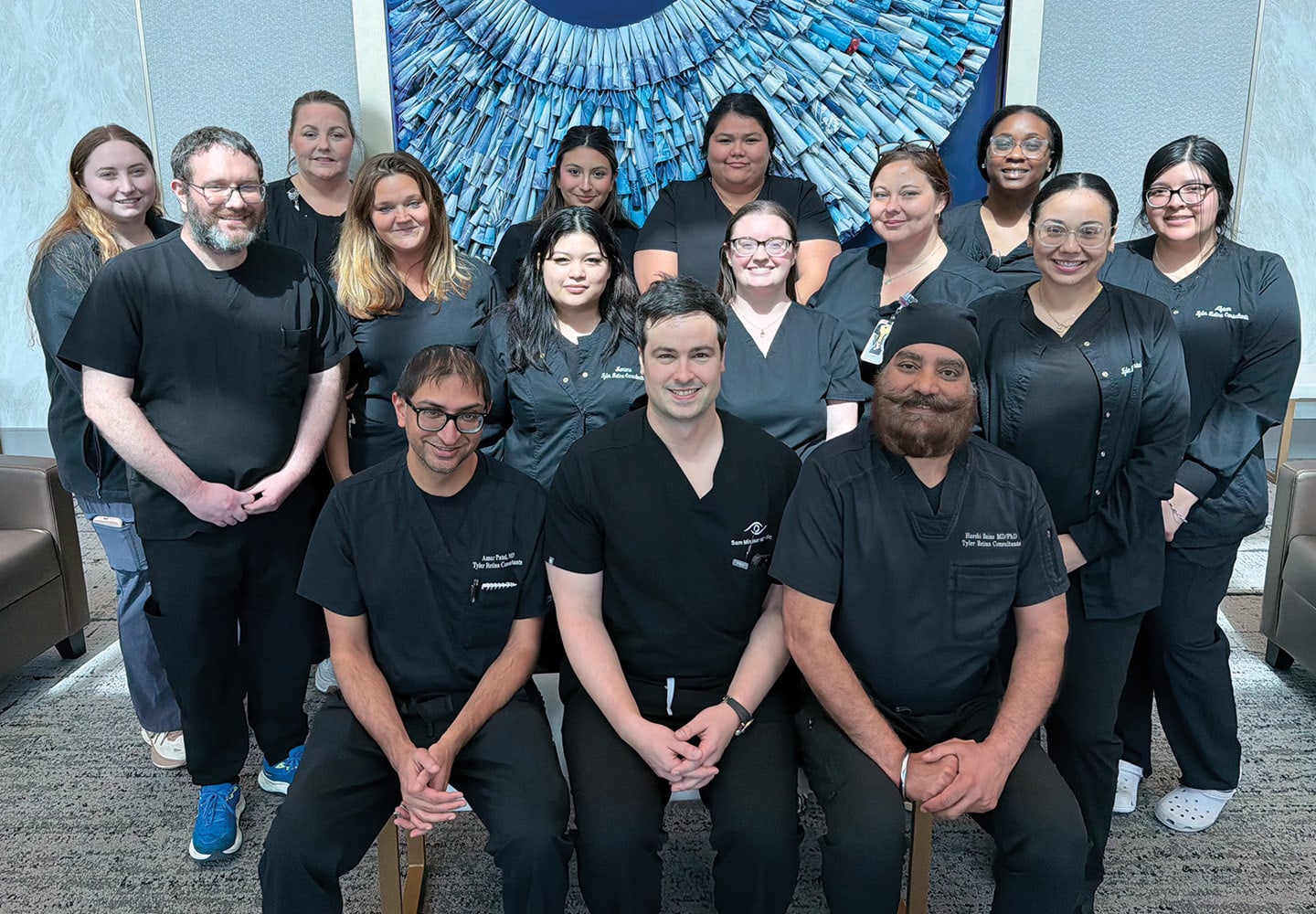
Figure 1. The clinical trials team at Tyler Retina Consultants includes director of clinical research Samuel A. Minaker, MD, MSc; clinical research manager Melissa Long; assistant clinical research manager Fatima Martinez; clinical research coordinators Abigail Betancourt, Brandy Luce, Kristy Martin, Lajia Taylor, Rachel Jackson, Rebecca Bravo, Sara Mott, Simran Vashi, Courtney Roseberry, Laura Cristobal, and Mariana Zuniga; BCVA examiners Bobby Grounds, Anabel Bravo, and Lizbeth Canchola; and subinvestigators Harshivinderjit S. Bains, MD, PhD, Amar Patel, MD, Gabriela Lahaie Luna, MD, and Rebecca Jones, MD.
The Network Comes Before the Program
Before I joined the practice, I had already spent several years building the industry relationships that would later help me expand its research program. I am 3 years out of fellowship, and as a young attending, I went to every industry dinner I could—not with any specific study in mind, but simply to get to know people. Months before I started at this practice, I began targeting trials that would be recruiting around the time I arrived, and I leaned on those relationships to ask sponsors to take a chance on a site that had not yet proven itself at that volume.
What sustained those relationships was delivering. Recruiting near the top of a study, keeping protocol deviations near zero, and being easy to work with are the 3 things sponsors tell each other about. Reputation compounds faster than I expected.
Build the Team Out of the Clinic You Already Have
At my previous practice, I learned something I have applied deliberately here: Promote from within rather than recruit experienced coordinators from outside. Retina is difficult to learn, and a scribe who has spent 2 years alongside a retinal physician already knows the diseases, imaging, and patients. Some of the best, most detail-oriented scribes I have worked with have thrived after being promoted into research. I am still awestruck watching a coordinator hold several protocols in memory and correct me in the lane.
Hiring this way also protects the culture—people grow together rather than arriving with someone else’s habits. When I got here, there were 8 research employees and about a dozen clinic staff with ambitions to move into research. That ambition was the most underrated asset in the building.
Buy-in Has to Be Seen to Be Believed
I did not persuade my partners or our clinic staff with a plan. Research patients disrupt a clinic day, and the investment I was going to ask for was substantial. The potential needed to be seen to be believed. Once the growth was visible, everyone moved quickly. We added roughly 3,000 square feet of dedicated research space in under a month, giving us an imaging suite and 2 additional exam lanes dedicated to best-corrected visual acuity (BCVA) testing and other trial-related assessments.
The strongest argument for investing in the program was what it could offer our patients. This is an underserved region, and trials give people access to investigational therapies and care they would otherwise not have. There is also something particular about practicing here: Patients volunteer because they want to help someone else, and many mention children or grandchildren who may be at risk for the same disease.
To keep the program from becoming “my” project, I put structure around it. We hold a weekly PI oversight meeting with the lead research staff and a twice-monthly meeting covering every study and its inclusion criteria, so the entire team knows what we are looking for. The clearest sign that it worked: On 2-doctor days, my partners now pull me into an exam lane to ask whether a patient might qualify.
Finding Patients Is Still a Human Process
We build relationships with referring physicians through referral dinners, which help bring new patients into the practice. We then identify potential trial candidates during their clinic visits. We do not yet have the capacity for systematic manual chart review the night before. Electronic medical record queries help, but they miss the nuance—a patient who screens out on paper is sometimes an excellent candidate, and the reverse is just as common. You find that out in conversation.
Screen failure is something practices underestimate, and in our experience, it varies far more by disease than by site. In neovascular age-related macular degeneration (AMD) or diabetic macular edema, our screen-failure rate is roughly 10% to 20%. In nonproliferative diabetic retinopathy, it is closer to 30% to 50%. In geographic atrophy or intermediate AMD, it can be 60% to 90%.
Prescreening images by hand helps more than anything else—scrolling through the entire optical coherence tomography cube rather than relying on a summary image and using autorefraction as a rough guide to what protocol refraction will show. Every avoidable screen failure costs a patient a day and costs your staff hours they do not have.
The Conversation at the Chair
The hardest conversation is with a patient who is doing well on an approved treatment. I frame it around the goal of the trial—fewer injections or better vision—and then I am straightforward about everything participation includes, such as fellow-eye coverage, transportation, and the stipend. Then I let the patient decide.
This should never be pushed. It is an opportunity we offer to every patient, not a favor we ask of them. Patients often enroll hoping for what the investigational product might deliver, and part of an honest conversation is making sure they understand that in a randomized study their treatment assignment is uncertain, so they may not receive the investigational therapy or experience a better outcome.
What Actually Strained, and What We Changed
Staffing and space were the bottlenecks all year, and the quick growth also put real pressure on regulatory startup. Our answer was to become more selective rather than more aggressive: a few large studies per disease state, plus a small number of early phase studies we are genuinely excited about. Fourteen trials sounds more chaotic than it is, because they are concentrated in a way that keeps the regulatory burden manageable and lets coordinators go deep on protocols instead of skimming a dozen.
Nothing has failed outright yet. I am sure something will.
The Economics Nobody Warns You About
The program ran at a loss before I arrived, and our senior partner was fine with that for a reason I have come to appreciate. In a busy clinic, you lose some of your best staff—to nursing school, to other careers—and research gives talented people somewhere to grow without leaving the practice. The staff we kept in that manner are exactly why we could ramp up this year: They bring newly promoted coordinators up to their level far faster than any outside hire could. A research program can be a retention strategy before it is ever a revenue line.
The thing I wish someone had told me is smaller and harder: how to keep the research team happy without making the clinic team feel underappreciated. Small gestures land unevenly. Buying coffee for one group can bother the other. Now that research has its own space and workflow, those moments are less visible, but word still travels fast in a retina clinic, and I am still learning how to balance it.
If You Are Thinking About Starting
If a practice can do only one thing first, identify a research manager. Then add a single BCVA lane and grow slowly into it rather than building for a volume you do not have yet. The DRCR Retina Network is a reasonable entry point for practices interested in participating in clinical research.
Trials InSight
Trials InSight, cofounded by Samuel Minaker, MD, MSc, and Deepak Sambhara, MD, FASRS, is a meeting for retina physicians and research coordinators focused on the operational aspects of clinical trials. The inaugural session will be held virtually on February 27, 2027, with programming intended for both established research sites and practices considering participation in clinical trials. For more information or to register, visit trials-insight.com.
Be honest about whether you are ready. If you do not have enough skilled staff or enough new referrals, the program will not grow at the rate you want, and a struggling research program will consume the attention your clinic needs. Grow the practice first. You need a healthy clinic before you can build a healthy research program.
Almost nothing I have described here is formally taught. Physicians often learn trial work by doing it, and coordinators—who carry much of the operational weight—have even fewer opportunities for formal training. That gap is one reason Deepak Sambhara, MD, FASRS, and I founded Trials InSight, a meeting designed to bring physicians and research coordinators together to discuss the operational aspects of retinal clinical trials.
None of what happened this year was mine alone, and the report card made that obvious. Melissa Long, our research manager; Fatima Martinez, our masked lead; Courtney Roseberry, our unmasked lead; and the rest of our team carry this program every day. I owe a great deal to Harshi Bains, MD, PhD, our senior partner, who was willing to invest in the idea before it paid for itself. The trials are the visible part. The team is the program. RP