



In drug development, clinical trial design establishes the framework for evaluating treatment effects and interpreting which efficacy claims and clinical conclusions are supported by the results. Distinguishing between showing that a treatment is better than a comparator (superiority) and showing that it is not worse by more than a prespecified margin (noninferiority) is important because the 2 trial designs address different clinical questions and support different conclusions.1 Understanding these differences is essential for neovascular age-related macular degeneration (nAMD) clinical development because modern registration trials may use either of these designs to compare new investigational therapies to established anti-VEGF agents with reliable and high efficacy. Trial design is key to interpreting clinical benefit compared to well-characterized treatments.
Clinical development often progresses from phase 1 trials assessing safety, tolerability, and dose; through phase 2 trials exploring efficacy and refining dose selection; to larger phase 3 trials confirming efficacy and safety to support regulatory approval.2
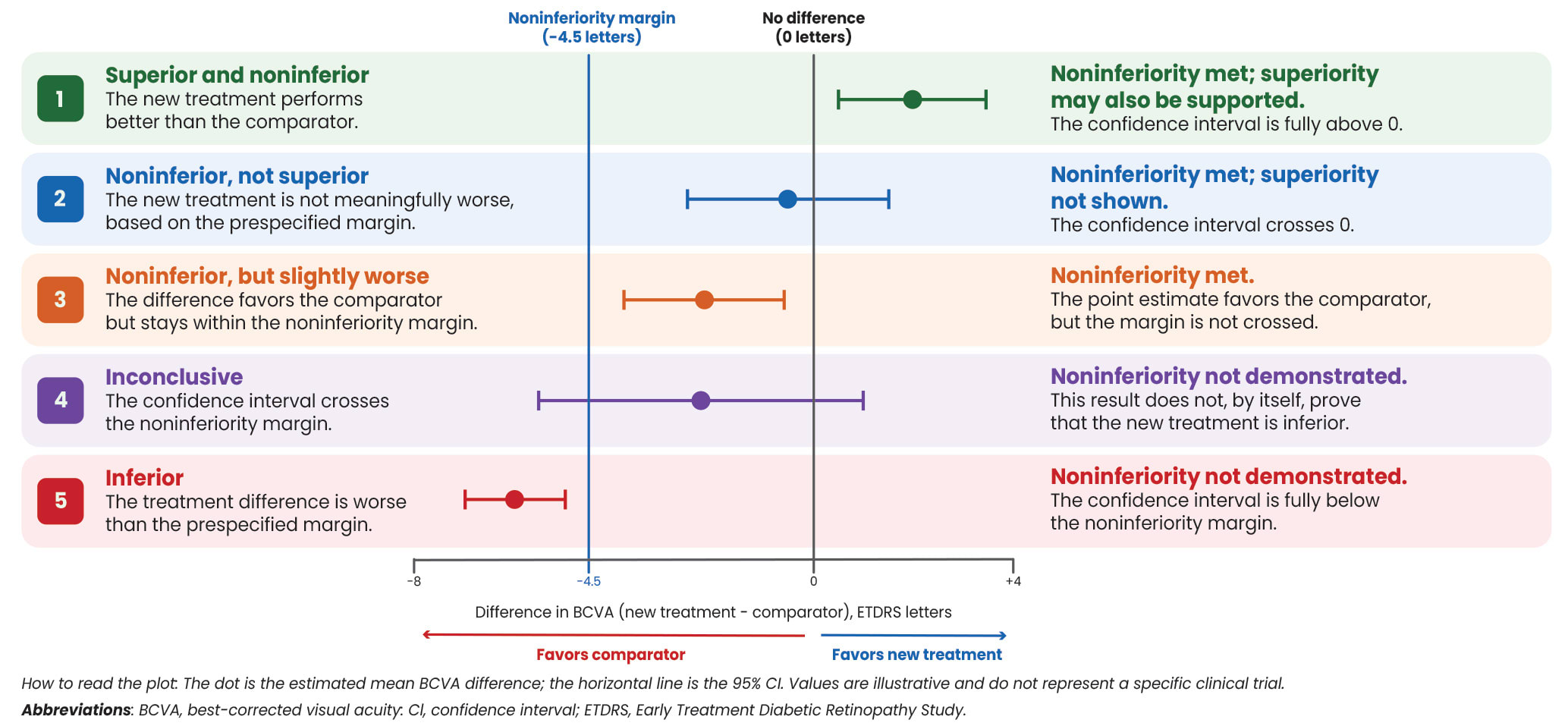
Figure 1. Possible outcomes in a noninferiority trial and what they mean. Each dot represents the estimated mean difference in best-corrected visual acuity between the investigational therapy and the active comparator, and the horizontal line represents the two-sided 95% confidence interval. Positive values favor the investigational therapy. Noninferiority is demonstrated when the lower bound of the confidence interval remains above the prespecified -4.5 ETDRS-letter margin. If the entire confidence interval also remains above 0, the result may support superiority, provided superiority testing is permitted by the prespecified statistical analysis plan. When the confidence interval crosses the noninferiority margin, noninferiority is not demonstrated; however, this does not by itself establish that the investigational therapy is inferior by more than the prespecified margin. Values are illustrative and do not represent results from a specific clinical trial.1,8,35
Understanding Superiority and Noninferiority Trials
The validity of a clinical study depends on its position in the broader hierarchy of clinical evidence and its statistical outcomes.3 Randomized controlled trials (RCTs) provide the strongest clinical evidence in experimental research.
Superiority and noninferiority trials can each use randomized controlled designs that address different clinical questions and rely on different interpretive assumptions. A positive superiority trial supports a conclusion that the investigational therapy outperformed the comparator on the prespecified endpoint, whereas a positive noninferiority trial supports a conclusion that the investigational therapy was not worse than the comparator by more than the prespecified margin.4 The P value addresses statistical significance, whereas the effect estimate (eg, standardized mean difference, odds ratio, or risk ratio) shows the magnitude of the effect, and the confidence interval conveys the uncertainty around that estimate. Together, these measures provide a more complete interpretation of the results beyond the P value.5
Noninferiority designs rely on the previously established efficacy of the active control in a particular patient population and therefore avoid a sham or placebo control group to determine whether the new investigational treatment is efficacious.1 In nAMD, the prespecified noninferiority margin for the difference between the investigational drug and the active control, either ranibizumab or aflibercept, is -4.5 Early Treatment Diabetic Retinopathy Study (ETDRS) letters when studied in an equivalent population to that which demonstrated efficacy with ranibizumab and aflibercept.6 This value is not the observed mean difference in BCVA between treatment groups; instead, it is the threshold against which the lower bound of the two-sided 95% confidence interval is compared. Noninferiority is demonstrated when the lower bound remains above -4.5 letters. If the entire confidence interval also remains above 0 in favor of the investigational therapy, the result may support superiority, provided this comparison is permitted by the prespecified statistical analysis plan.
Figure 1 illustrates the most common result patterns. Importantly, failure to demonstrate noninferiority is not, by itself, proof that the investigational therapy is inferior. This distinction is exemplified by the Comparison of Age-Related Macular Degeneration Treatment Trials (CATT) study, which compared ranibizumab to bevacizumab either monthly or as needed for 1 year. Treatment comparisons within each regimen met the noninferiority standard, but comparisons of monthly vs as-needed bevacizumab and monthly ranibizumab vs as-needed bevacizumab were inconclusive because the lower bound of the 95% confidence interval crossed the noninferiority margin.7 This did not mean the as-needed regimens were inferior, but that noninferiority could not be established from the data.
While it is possible to interpret superiority from a planned noninferiority study, adhering to the prespecified trial type ensures the analysis is interpretable given its sensitivity, sample size, comparators, populations, and endpoints.1,8
Why Trial Design Differences Matter
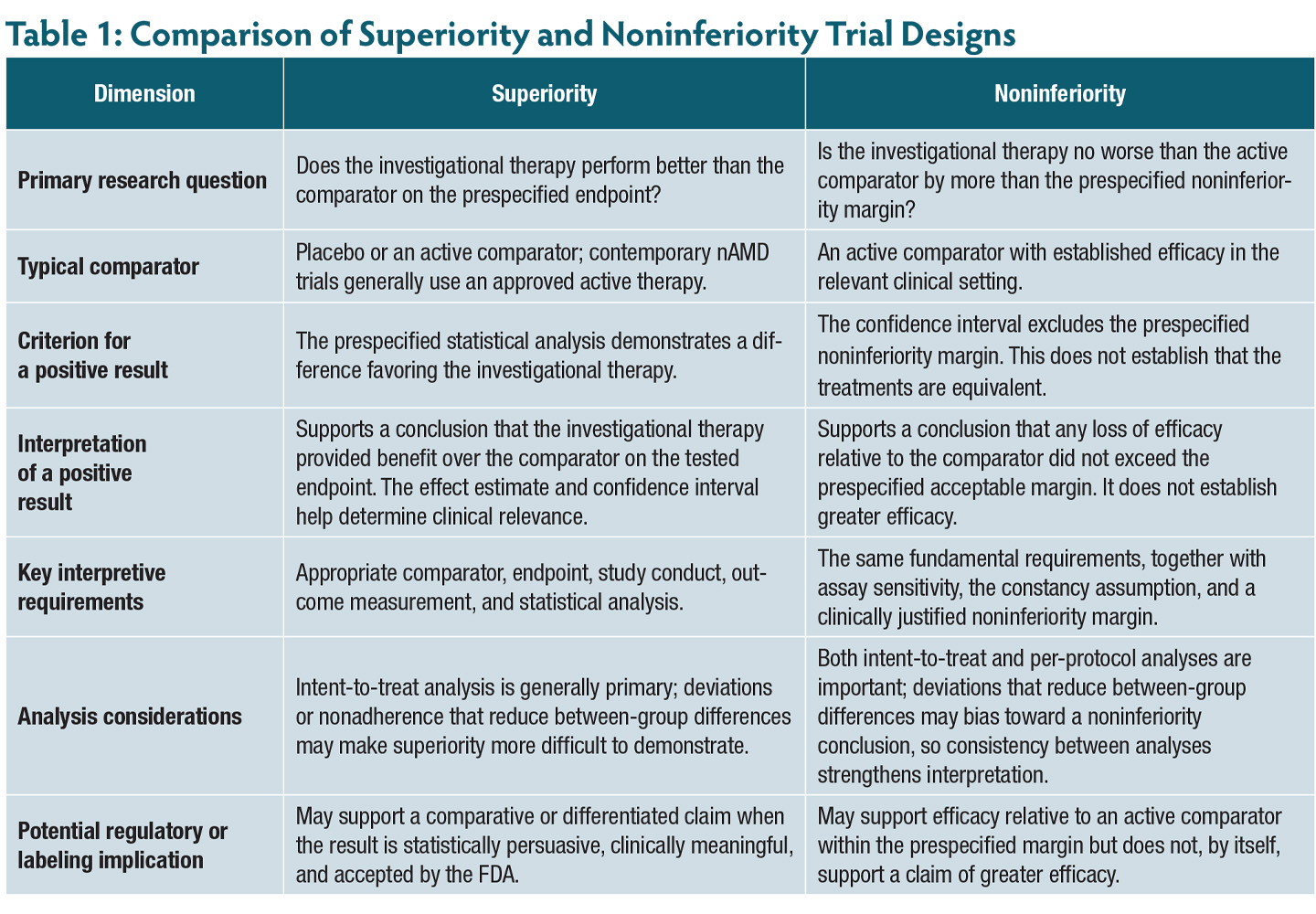
Superiority and noninferiority trials support fundamentally distinct research questions (Table 1). A positive superiority trial provides direct evidence that the investigational therapy outperformed the comparator on the prespecified endpoint. This result is generally more straightforward to interpret because it does not depend on the additional assumptions specific to a noninferiority analysis.1 Noninferiority trials address a different question and require additional assumptions, including the established efficacy of the active comparator, the particular study population, and the appropriateness of the prespecified noninferiority margin.
Demonstrating superiority is not necessarily needed to support approval of a particular product. When achieved on a prespecified, clinically meaningful endpoint, superiority directly supports a conclusion of benefit over the comparator on that endpoint and may support differentiated labeling, subject to regulatory review. Achievement of superiority on an established primary outcome may be particularly meaningful in the current nAMD landscape, where no new therapy has demonstrated superiority to an FDA-approved treatment since ranibizumab outperformed photodynamic therapy (PDT) in the landmark ANCHOR trial.9
When One Pivotal Trial May Support Approval
The FDA pathway to drug approval has evolved significantly. Safety alone was required for marketing approval until 1962, when both efficacy and safety became mandatory.10 Traditionally, results from at least 2 adequate and well-controlled trials have been interpreted as the clearest path to generating adequate safety and efficacy data. However, the FDA has long recognized circumstances in which it can approve drugs based on a single pivotal study accompanied by confirmatory evidence.11,12
In 2026, the FDA issued revised draft guidance open to public comment describing the circumstances in which 1 adequate and well-controlled clinical investigation, together with confirmatory evidence, may satisfy the substantial- evidence standard.13,14
The historical reliance on 2 clinical trials was intended to reduce the chance of finding a treatment effect when one does not exist (type I error). Historically, 2 independent positive trials substantially reduced the likelihood that an apparent treatment effect resulted from chance. Today, biomedical advances may allow more precise mechanism of action mapping and target identification, which could grant a greater degree of credibility to investigational products before clinical trials begin. Modern trials are also designed more purposefully to enhance their credibility with a greater focus on robust and strict criteria for hypothesis testing, statistical power, blinding, independent review, and selection of key design elements. Since 2009, clinical trial success rates in ophthalmology and other therapeutic areas have steadily increased, which has been attributed to more careful candidate selection, integration of biomarkers into drug development, and accelerated translation of breakthrough therapies, although it remains common for current clinical trials to fail to demonstrate their proposed hypothesis.15
Confirmatory evidence provides further justification to support approval decisions. Confirmatory evidence includes data from related indications or the same pharmacologic class; mechanistic or pharmacodynamic studies; animal models; and evidence from natural history, real-world, and expanded-access studies.16
Pursuing single-trial approval requires the pivotal trial to be highly unlikely to have occurred by chance (P<.001) and to have occurred in a population so small as to make it difficult to repeat. To undertake a single-trial path, the FDA recommends early discussions with appropriate divisions to discuss the design, confirmatory evidence, and rationale.16
The 1-trial approach may have the potential to improve development efficiency by reducing the time and resources required to plan and execute multiple studies, but patient enrollment must be sufficiently large to meet rigorous statistical standards. A second phase 3 trial may still be required to meet sample size and follow-up requirements for safety data.
The trend towards single-trial approvals was already evident before the 2026 announcement. Across therapeutic areas, the proportion of novel drugs approved based on 2 pivotal trials has decreased from 80.6% in 1995-1997 to 52.8% in 2015-2017.17 Although this trend was evident for approvals considered under a special regulatory program or for orphan-designated drugs, in 2024 and 2025 single-trial approvals represented more than half of all approvals and more than 40% of non–orphan drug approvals.18
Precedent for single-trial approvals in ophthalmology remains limited, although the FDA has recently confirmed alignment on single-trial pathways for emerging ophthalmic therapies.19-21 One example of a single-trial approval is Xipere (Clearside Biomedical), an injectable suspension of triamcinolone acetonide, approved in 2021 to treat uveitic macular edema based on results from the PEACHTREE trial, which met its primary efficacy endpoint (P<.001), while safety was established in the open-label AZALEA study.22-24 More recently, aflibercept 8 mg (Eylea HD; Regeneron) received approval based on a single pivotal trial in each indication, with PULSAR supporting nAMD and PHOTON supporting diabetic macular edema; however, it should be noted in this instance that this is an additional strength added to an established drug product where 1 trial would be acceptable in a post-approval setting.25
These examples illustrate the evolving regulatory standard presented in the FDA’s revised 2026 draft guidance, affirming that—in appropriate circumstances—1 scientifically rigorous, adequate and well-controlled investigation, together with confirmatory evidence, may satisfy the statutory substantial-evidence standard.13 The nature and strength of the confirmatory evidence remain program-specific and should be evaluated within the totality of the evidence, including the design, conduct, analysis, and persuasiveness of the principal investigation.
Special Protocol Assessment
Sponsors can initiate a special protocol assessment (SPA) with the FDA to discuss key elements of a clinical trial.18 An SPA agreement documents alignment on a proposed study’s critical elements—including entry criteria, dose selection, endpoints, sample size, and planned statistical analyses—according to the FDA’s standards. It does not address whether 1 or more than 1 clinical trial will be necessary for approval. Obtaining written alignment on key aspects of the trial can reduce regulatory risk and help prevent costly trial decisions. For example, prospectively defined primary and secondary endpoints, analysis populations, and statistical methods form the basis for confirmatory inference and should be identified in alignment with the FDA’s standards.18 Post hoc or ad hoc analyses that were not prespecified in the protocol or statistical analysis plan are generally exploratory and should not, on their own, be interpreted as establishing efficacy when the primary analysis is not met.19,20 Alignment before trial initiation reduces ambiguity regarding which analyses can legitimately support claims.
SPA agreement does not guarantee acceptance of an NDA because it only addresses study design of a single trial, but FDA feedback during development can help guide sponsor strategy. The FDA outlines requirements for submitting a request and procedures for reaching agreement.18 Generally, the FDA reviews critical elements of the protocol, responds to questions from the sponsor, and advises on important considerations. At this stage, sponsors can also identify potential labeling statements and the associated aspects of the protocol intended to support them. If agreement is not reached on the first submission, sponsors can resubmit with appropriate protocol changes.
After agreement is reached, modifications to the SPA may be allowed if both the sponsor and the FDA agree to the amendment. Deviations from the agreed-upon protocol are handled during the active review of the NDA.18 In an era of increasingly complex and multifaceted clinical trials, an SPA can be valuable in reducing regulatory uncertainty.
Pivotal Trial Designs Supporting FDA Approval of nAMD Therapies
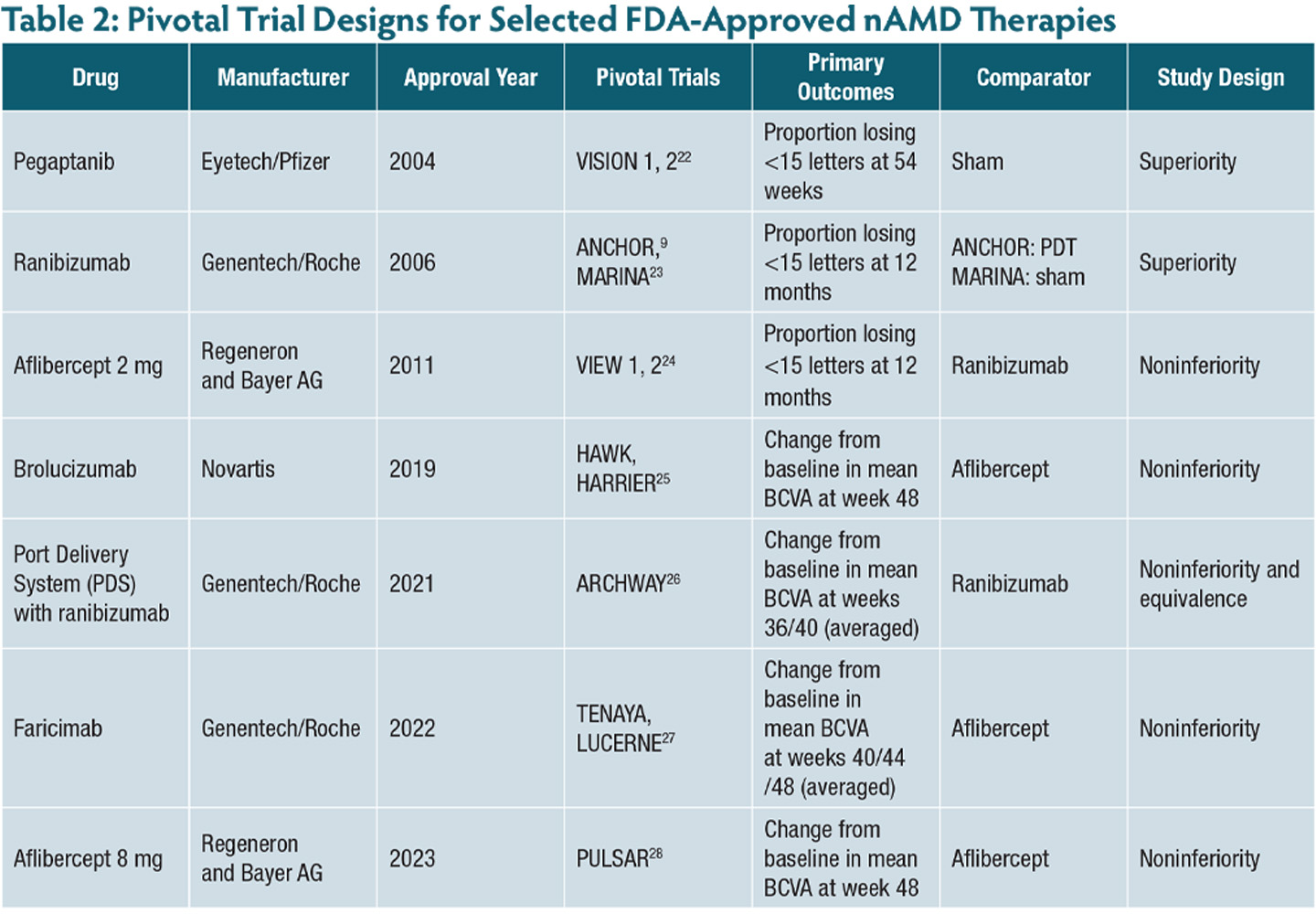
In nAMD trials, as development increasingly focuses on sustained disease control and greater durability while maintaining efficacy, clinical trial design and the totality of the data are important considerations. For example, many current trials include a loading phase with multiple anti-VEGF injections, which should be considered when assessing the treatment burden associated with the evaluated drug (Table 2). Furthermore, durability may be characterized through prespecified supportive measures, such as the proportion of patients who remain free of supplemental injection and the time to first supplemental injection.21 These measures may characterize durability, but they do not independently establish efficacy and should be interpreted alongside the prespecified visual acuity and anatomical outcomes, safety, and total treatment exposure, including loading and supplemental administrations. A reduction in treatment administrations alone does not establish efficacy.6
Recent FDA Draft Guidance for Drugs Intended to Treat nAMD
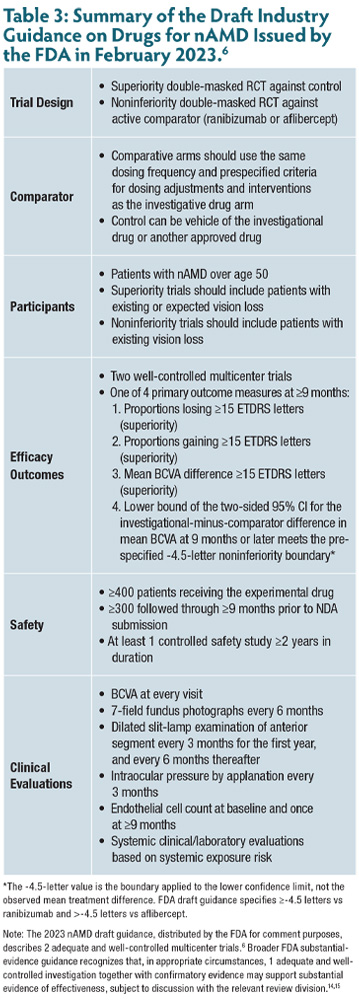
In February 2023, the FDA issued draft guidance to industry proposing to clarify its recommendations for evaluating nAMD drugs (Table 3).6 As with all draft guidance documents, the document was designed for comments, not implementation; however, draft guidance documents do reflect the agency’s current thinking on a given matter.
Study Design and Controls
Randomized, double-masked trials are recommended for superiority and noninferiority studies. Sham injections are not a recommended control because patients and clinicians may detect whether treatment or sham was administered, which may introduce bias specifically towards subjective performance-based outcomes such as visual acuity, effectively unmasking both parties and compromising efficacy endpoints.26 On the other hand, intravitreal injections have inherent risks, although serious risks are rare,27 and injecting inactive vehicle usually confers no potential benefit and could potentially lead to ocular complications. Alternatively, investigational agents can often be compared to an existing approved drug employing the same dosing frequency and prespecified criteria for dosing adjustments and interventions as the investigational agent. Each experimental drug arm needs at least 1 control arm with the same dosing schedule.6
Prior to the FDA proposed guidance for the development of nAMD drug products (2023), phase 3 studies of aflibercept 2 mg (Eylea; Regeneron), brolucizumab (Beovu; Novartis), faricimab (Vabysmo; Genentech), and aflibercept 8 mg (Eylea HD; Regeneron) implemented application of longer dosing interval criteria for the experimental drug which was not applied to the comparator arm.28-31 This new limitation results in a design challenge in nAMD trials that aim to demonstrate superior durability. Matching the dosing schedule of the investigational drug to the control’s schedule would prohibit extending dosing intervals of only the investigational drug; matching the control’s schedule to an aspiring investigational drug’s extended interval could demonstrate less frequent dosing than needed for the on-label regimen.
Supplemental Treatment
Prespecified criteria for supplemental treatments are included in trials evaluating durability for patient safety. However, supplemental use of a second agent may blur the distinction between disease control attributable to the assigned therapy alone vs that achieved with supplemental treatment(s).32 Depending on the prespecified analysis, patients requiring multiple supplemental treatments may be classified as treatment failures. The number and timing of supplemental injections must therefore be reported.
Prespecified analyses restricted to patients who remain supplement-free provide useful supportive information regarding investigational drug durability, but they should not be interpreted as equivalent to the prespecified primary analysis in the full randomized population. Supplemental treatment administered near the primary endpoint may influence visual acuity outcomes differently from treatment administered earlier in the study and requires careful consideration in the efficacy analysis.32
Outcomes
Visual acuity outcomes are often the recommended primary efficacy endpoint.6 Anatomical outcomes, such as retinal fluid or central retinal thickness on optical coherence tomography (OCT), are typically secondary outcomes, but often do not correlate with visual function. Of note, noninferiority designs with interval extension or shortening criteria for only the investigational drug cannot claim superiority for subgroups that demonstrate interval extension. Similarly, a reduction in the number of treatment administrations alone is not sufficient to demonstrate efficacy.6A favorable result on a treatment-burden secondary endpoint does not establish superiority of visual function.32 In these cases, the absence of a superiority claim may limit clinical differentiation and could influence clinical adoption and payer coverage considerations. The FDA expects superiority study claims to show either a smaller proportion of eyes losing ≥15 ETDRS letters, a greater proportion gaining ≥15 letters, or a mean difference in BCVA of ≥15 letters.6 The 15-letter threshold provides greater confidence that a true change in vision has occurred, since smaller changes can lie within the normal variability of repeated BCVA tests.33
Statistical Analysis
Statistical analysis plans are prespecified before unblinding to reduce bias.13 Protocol deviations, treatment crossover, nonadherence, and other factors may attenuate differences between study groups. In superiority trials, this generally biases results toward no difference; in noninferiority trials, it may bias results toward a conclusion of noninferiority. For this reason, multiple estimands are important in both noninferiority and superiority trials, and consistency between them strengthens interpretation of the results.1
Analyses also require multiplicity-control methods and hierarchical testing to reduce the risk of type I error when multiple products, endpoints, or timepoints are assessed.34 Type I error is a false positive conclusion when a null hypothesis is incorrectly rejected. The probability of such an error increases with each independent endpoint tested. Under a hierarchical framework, statistical significance for secondary outcomes can be claimed only when prior endpoints in the hierarchy are significant; otherwise, associated P-values are generally considered nominal and should not be interpreted as confirmatory unless the prespecified multiplicity strategy permits formal inference.34 Results should also be interpreted using the treatment-effect estimate and confidence interval alongside the P-value.1,6
Implications for Future Development
Evolving regulatory and clinical expectations will continue to shape future nAMD clinical development programs. Noninferiority studies can show that a new therapy is similar in efficacy (within a prespecified margin) to an approved therapy, while superiority studies assess whether an investigational therapy provides greater clinical benefit on a prespecified endpoint and may offer greater potential for differentiation in a treatment landscape saturated with effective therapies.1,4 As development increasingly focuses on durability, thoughtful clinical trial design and outcome reporting are essential to ensure that sustained efficacy is appropriately assessed. Durability and anatomic outcomes should be interpreted according to their prespecified position in the endpoint hierarchy and alongside the primary visual function endpoint, while safety findings contribute to the overall benefit-risk assessment.6,34
As FDA guidance continues to evolve regarding nAMD trial designs, careful attention to prespecified endpoints, statistical analysis, safety, and the totality of evidence will remain necessary. RP



REFERENCES
1. US Food and Drug Administration. Noninferiority clinical trials to establish effectiveness: guidance for industry. US Department of Health and Human Services, Food and Drug Administration. November 2016. Accessed October 12, 2026. https://www.fda.gov/media/78504/download
2. US Food and Drug Administration. The drug development process. Step 3: clinical research. January 4, 2018. Accessed October 12, 2026. https://www.fda.gov/patients/drug-development-process/step-3-clinical-research
3. Centre for Evidence-Based Medicine, University of Oxford. OCEBM Levels of Evidence. Accessed October 12, 2026. https://www.cebm.ox.ac.uk/resources/levels-of-evidence/ocebm-levels-of-evidence
4. Piaggio G, Elbourne DR, Pocock SJ, Evans SJ, Altman DG, Group C. Reporting of noninferiority and equivalence randomized trials: extension of the CONSORT 2010 statement. JAMA. 2012;308(24):2594-2604. doi:10.1001/jama.2012.87802
5. Ranganathan P, Pramesh CS, Buyse M. Common pitfalls in statistical analysis: clinical vs statistical significance. Perspect Clin Res. 2015;6(3):169-170. doi:10.4103/2229-3485.159943
6. US Food and Drug Administration. Neovascular age-related macular degeneration: developing drugs for treatment: guidance for industry (draft guidance). February 2023. Accessed October 12, 2026. https://www.fda.gov/media/165606/download
7. CATT Research Group, Martin DF, Maguire MG, et al. Ranibizumab and bevacizumab for neovascular age-related macular degeneration. N Engl J Med. 2011;364(20):1897-1908. doi:10.1056/NEJMoa1102673
8. Committee for Proprietary Medicinal Products. Points to consider on switching between superiority and non-inferiority. Br J Clin Pharmacol. 2001;52(3):223-228. doi:10.1046/j.0306-5251.2001.01397-3.x
9. Brown DM, Kaiser PK, Michels M, et al. Ranibizumab versus verteporfin for neovascular age-related macular degeneration. N Engl J Med. 2006;355(14):1432-1444. doi:10.1056/NEJMoa062655
10. US Food and Drug Administration. Drugs and foods under the 1938 act and its amendments. Updated February 1, 2018. Accessed October 12, 2026. https://www.fda.gov/about-fda/changes-science-law-and-regulatory-authorities/part-iii-drugs-and-foods-under-1938-act-and-its-amendments
11. Morris L. FDA modernization act: implications for oncology. Oncology (Williston Park). 1998;12(11A):139-141.
12. US Food and Drug Administration. Guidance for industry on providing clinical evidence of effectiveness for human drug and biological products; availability. Fed Regist. 1998;63(94):27093-27095. Accessed October 12, 2026. https://www.govinfo.gov/content/pkg/FR-1998-05-15/pdf/98-12901.pdf
13. US Food and Drug Administration. Demonstrating substantial evidence of effectiveness for human drug and biological products: draft guidance for industry. June 2026. Accessed October 12, 2026. https://www.fda.gov/media/133660/download
14. Prasad V, Makary MA. One pivotal trial, the new default option for FDA approval—ending the two-trial dogma. N Engl J Med. 2026;394(8):815-817. doi:10.1056/NEJMsb2517623
15. Wong CH, Siah KW, Lo AW. Estimation of clinical trial success rates and related parameters. Biostatistics. 2019;20(2):273-286. doi:10.1093/biostatistics/kxx069
16. US Food and Drug Administration. Demonstrating substantial evidence of effectiveness with one adequate and well-controlled clinical investigation and confirmatory evidence: guidance for industry (draft guidance). September 2023. Accessed October 12, 2026. https://www.fda.gov/media/172166/download
17. Zhang AD, Puthumana J, Downing NS, Shah ND, Krumholz HM, Ross JS. Assessment of clinical trials supporting US Food and Drug Administration approval of novel therapeutic agents, 1995-2017. JAMA Netw Open. 2020;3(4):e203284. doi:10.1001/jamanetworkopen.2020.3284
18. Kaiser PK. Single Trial Approval Pathway in the US FDA. Pesented at: Asia-Pacific Vitreo-retina Society; August 28, 2026 2026; Queensland, Australia. https://investors.ocutx.com/static-files/90672b21-772d-4ad5-a0d5-0faee9e1ec5d
19. FDA alignment boosts wet AMD treatment path. The Ophthalmologist. July 7, 2026. Accessed October 31, 2026. https://www.theophthalmologist.com/issues/2026/articles/july/fda-alignment-boosts-wet-amd-treatmentpath/
20. OKYO Pharma reports positive feedback from FDA type D meeting and accelerates urcosimod into global phase 3 pivotal trial for neuropathic corneal pain. Securities and Exchange Commission. July 8, 2026. Accessed October 31, 2026. https://www.sec.gov/Archives/edgar/data/1849296/000149315226032407/ex99-1.htm
21. FDA confirms single pivotal trial pathway for Elate Ocular. Press release. April 23, 2026. Accessed October 31, 2026. https://announcements.asx.com.au/asxpdf/20260423/pdf/06yskgpmr8xj20.pdf
22. Yeh S, Khurana RN, Shah M, et al. Efficacy and safety of suprachoroidal CLS-TA for macular edema secondary to noninfectious uveitis: phase 3 randomized trial. Ophthalmology. 2020;127(7):948-955. doi:10.1016/j.ophtha.2020.01.006
23. Bausch + Lomb. XIPERE [package insert]. Alpharetta, GA; Revised 2025. Accessed October 31, 2026. https://www.accessdata.fda.gov/drugsatfda_docs/label/2021/211950s000lbl.pdf).
24. Henry CR, Shah M, Barakat MR, et al. Suprachoroidal CLS-TA for non-infectious uveitis: an open-label, safety trial (AZALEA). Br J Ophthalmol. 2022;106(6):802-806. doi:10.1136/bjophthalmol-2020-318019
25. EYLEA HD (aflibercept) injection 8 mg approved by FDA fortTreatment of wet age-related macular degeneration (wAMD), diabetic macular edema (DME), and diabetic retinopathy (DR). Press release. August 18, 2023. Accessed October 31, 2026. https://investor.regeneron.com/news-releases/news-release-details/eylea-hd-aflibercept-injection-8-mg-approved-fda-treatment-wet/
26. Boyd B. Q&A with the FDA. American Academy of Ophthalmology Annual Meeting. Chicago, IL, 2024.
27. American Academy of Ophthalmology. Age-related macular degeneration preferred practice pattern 2024 - Updated 2026. February 2025. Accessed October 31, 2026. https://www.aao.org/education/preferred-practice-pattern/age-related-macular-degeneration-ppp
28. Heier JS, Brown DM, Chong V, et al. Intravitreal aflibercept (VEGF trap-eye) in wet age-related macular degeneration. Ophthalmology. 2012;119(12):2537-2548. doi:10.1016/j.ophtha.2012.09.006
29. Dugel PU, Dugel PU, Singh RP, et al. HAWK and HARRIER: ninety-six-week outcomes from the phase 3 trials of brolucizumab for neovascular age-related macular degeneration. Ophthalmology. 2021;128(1):89-99. doi:10.1016/j.ophtha.2020.06.028
30. Khanani AM, Kotecha A, Chang A, et al. TENAYA and LUCERNE: two-year results from the phase 3 neovascular age-related macular degeneration trials of faricimab with treat-and-extend dosing in year 2. Ophthalmology. 2024;131(8):914-926. doi:10.1016/j.ophtha.2024.02.014
31. Korobelnik JF, Lanzetta P, et al. Intravitreal aflibercept 8 mg in neovascular age-related macular degeneration: ninety-six-week results from the randomized phase 3 PULSAR trial. Ophthalmology. 2026;133(1):39-50. doi:10.1016/j.ophtha.2025.08.022
32. US Food and Drug Administration. E9(R1) Statistical principles for clinical trials: addendum: estimands and sensitivity analysis in clinical trials: guidance for industry. US Department of Health and Human Services, Food and Drug Administration, Center for Drug Evaluation and Research (CDER) and Center for Biologics Evaluation and Research (CBER); May 2021. Accessed August 13, 2026. https://www.fda.gov/media/148473/download.
33. van der Zee C, Muijzer MB, Claessens JLJ, Wisse RPL. Determining the variability associated with visual acuity and refractive error measurements: a systematic review. Ophthalmology. 2025;132(9):1020-1032. doi:10.1016/j.ophtha.2025.04.021
34. US Food and Drug Administration. Multiple endpoints in clinical trials: guidance for industry. US Department of Health and Human Services, Food and Drug Administration, Center for Drug Evaluation and Research (CDER) and Center for Biologics Evaluation and Research (CBER); October 2022. Accessed August 13, 2026. https://www.fda.gov/media/162416/download.
35. Aberegg SK, Hersh AM, Samore MH. Empirical consequences of current recommendations for the design and interpretation of noninferiority trials. J Gen Intern Med. 2018;33(1):88-96. doi:10.1007/s11606-017-4161-4
36. Gragoudas ES, Adamis AP, Cunningham ET Jr, et al. Pegaptanib for neovascular age-related macular degeneration. N Engl J Med. 2004;351(27):2805-2816. doi:10.1056/NEJMoa042760
37. Rosenfeld PJ, Brown DM, Heier JS, et al. Ranibizumab for neovascular age-related macular degeneration. N Engl J Med. 2006;355(14):1419-1431. doi:10.1056/NEJMoa054481
38. Holekamp NM, Campochiaro PA, Chang MA, et al. Archway randomized phase 3 trial of the Port Delivery System with Ranibizumab for neovascular age-related macular degeneration. Ophthalmology. 2022;129(3):295-307. doi:10.1016/j.ophtha.2021.09.016