



Duravyu (formerly EYP-1901; EyePoint Pharmaceuticals) demonstrated dual antiangiogenic and anti-inflammatory activity in preclinical studies, according to data presented at the Association for Research in Vision and Ophthalmology (ARVO) annual meeting. The sustained-release intravitreal insert delivers the tyrosine kinase inhibitor (TKI) vorolanib for at least 6 months and has shown pan-VEGF receptor inhibition, along with suppression of interleukin-6 (IL-6) signaling through janus kinase 1 (JAK1).
In his presentation, “Vorolanib Inhibition of IL-6 Signaling: A Novel Multi-Mechanism of Action for EYP-1901 in Retinal Exudative Diseases,” Rishi P. Singh, MD, chair of Ophthalmology at Mass Eye and Ear and Harvard Medical School, reviewed findings suggesting that vorolanib may target multiple disease pathways relevant to retinal vascular and exudative diseases.
“Diseases such as wet age-related macular degeneration and diabetic macular edema are multifactorial, involving excessive blood vessel formation in the eye in addition to inflammatory processes,” Dr. Singh said. “Ongoing work shows that vorolanib works in a unique way to address both of these aspects of retinal disease simultaneously.”
Methods
With a focus on kinases known to play a role in retinal disease, a primary kinase screen was conducted using the gold-standard radiometric assay under vendor-recommended conditions. Further analysis was carried out to ascertain potency from IC50 curves. Impact of vorolanib on IL-6 signaling was evaluated in vitro using reporter assays, and in silico modeling was completed to simulate interaction of vorolanib with target kinases, Dr. Singh explained.
Results
Dr. Singh pointed out that a primary kinase screen identified vorolanib as a potent inhibitor of JAK1 (95.1±1.1% SD inhibition)—JAK1 is a critical transducer of IL-6-mediated pro-inflammatory signaling through the IL-6R/gp130 receptor complex.
“The vorolanib IC50 value for JAK1 is in the potent range, indicating JAK1 would be inhibited at clinically relevant concentrations following EYP-1901 dosing,” said Dr. Singh. “In cell-based reporter assays, vorolanib was shown to substantially inhibit IL-6 activity.” Dr. Singh also noted that ocular pharmacokinetic/tissue distribution studies in Dutch-belted rabbits confirm consistent vorolanib levels >IC50 for JAK1 in the retina, indicating sustained inhibition. In silico modelling supported stable interaction between vorolanib and the ATP binding region of JAK1.
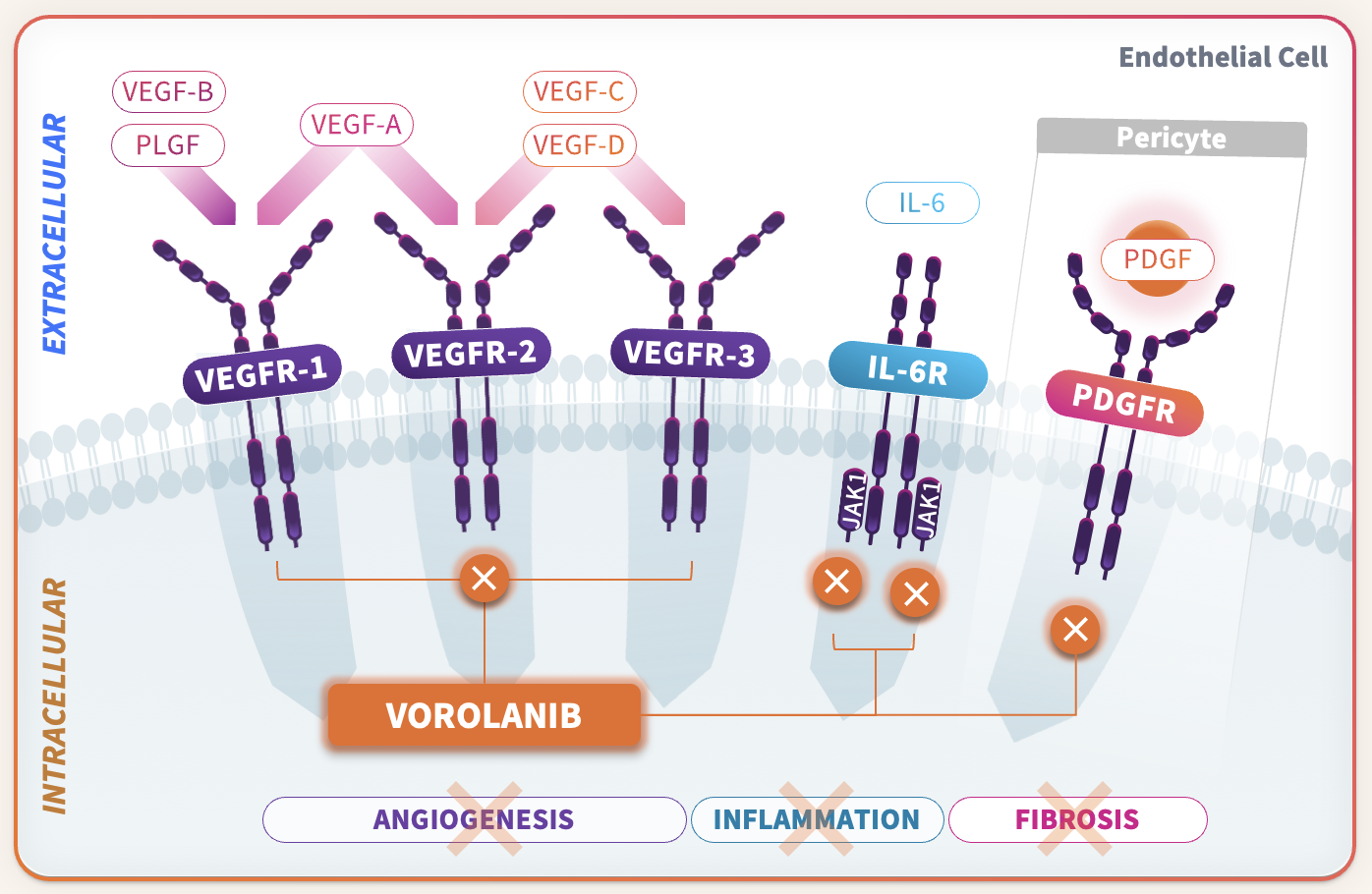
“The goals of the tyrosine kinase drugs that was discussed in the poster are drugs that can cut down intracellular VEGF levels,” said Dr. Singh. “We are obviously dealing with drugs in the past that have cut down extracellular VEGF levels, but the intracellular VEGF levels have never been touched. Vorolanib is one of those drugs that's being tested in a Durasert sustained release delivery platform that have shown benefit in patient populations overall.”
Dr. Singh added that it has been studied in a phase 1, a phase 2 study, as well as in DME, and in age-related macular degeneration (AMD), and found to have benefit in those patient populations.
“The poster looked a little deeper at the mechanism because vorolanib or any of these TKIs don't just have one function at decreasing VEGF levels, they might have other pathways that can affect,” explained Dr. Singh. “One of the bigger pathways that's been talked about recently is around interleukin-6, a well-known chemokine that occurs because of inflammation. We know that elevated IL-6 levels have been associated with worse vision outcomes, and through this pathway of JAK kinases that it promotes vascular leakage and neovascularization. So, if you can turn this off, it's really great.”
Dr. Singh further explained that what he and his coauthors looked at in this study was the inhibition of vorolanib, sunitinib, and axitinib and their ability to decrease JAK kinases, and the effect of the other kind of pathways there.
“It found to be very potent at decreasing JAK kinases and essentially IL-6 delivery,” he said. “This goes along the multimodal therapeutic option that vorolanib offers. It's not just that there's vorolanib, a TKI that affects downstream VEGF signaling. It also affects IL-6 signaling together, and that gives us a sense of what might be the benefit of this drug in patient populations.”
Dr. Singh concluded, “I think this is an exciting time. We have new therapeutic options on the horizon. The 2 studies that are the LUGANO/LUCIA trials are coming out later this year, which are really incredibly important for us to see the validity of this TKI in patient populations.” RP